Made by the Jam Handy organization for Chevrolet, “Be An A*C*E* Driver” is a campy driver’s ed film featuring Miss Jr. Miss for 1967, Rosemarie Dunaway Trible of Arkansas. The “A.C.E. system” centers on the words Alert, Courteous, and Education. The film opens with slot-car racing model cars on a miniature race track (0:07–0:54). Miss Rosemarie Dunway from Little Rock, Arkansas, makes an appearance on screen (0:59), followed by an explanation of what it means to be an A.C.E. driver (3:09). The narrator kicks off the film’s first section on alertness (3:28), showcasing a 1967 Chevrolet Caprice cruising down a street (3:10) and passing by a parked 1961 Oldsmobile Dynamic 88 (4:16). Scenes then depict a 1966 Pontiac GTO Street Machine emerging from behind a Hertz truck (4:44) and a Mercury Comet pulling in front of the film’s driver (4:53). The film further features a 1966 Chevrolet Chevelle on the freeway (5:01) and a 1968 Chevy Camaro hitting a pillar on the freeway (5:30) as the narrator delves into highway hypnosis (6:43). Footage includes a 1967 Chevrolet Impala on the road (7:59) before transitioning to the film’s section on courtesy (8:06), displaying a 1969 Volkswagen Type 3 tailgating (9:14). The film then moves into the third section on being an educated driver (9:36), featuring a 1967 Chevrolet Camaro turning a corner (10:06) and concluding with a red Chevrolet Camaro turning into a driveway.(12:47). The film ends (13:55). The overall message encourages young drivers to stay focused, be considerate of others, and continuously improve their skills both in the classroom and on the road to ensure safety and success. 00:00 Introduction to Rosemary Dunway, America’s Junior Miss for 1967.0:57 – Rosemary introduces Rick, who is teaching her about slot car racing, and emphasizes the competitive spirit.1:00:Rick explains how mistakes on the road can have serious consequences, unlike in racing.1:28 : Emphasizing the importance of driving with skill, control, and focus. 1:47:- Rick is described as an “all-around ace driver” and the meaning of being an ace is introduced.2:06 : Rosemary discusses how being an ace involved being alert, courteous, and educated, which were factors in winning the Junior Miss title. 2:53 : Comparisons are made between being an ace driver and an ace in other fields, emphasizing the qualities of alertness, courtesy, and education.3:19: Explanation of the qualities of an alert driver, like spotting potential dangers, reacting to hazards, and handling situations calmly, including children running into the street or parked cars pulling out.4:09:The dangers of target fascination, where drivers focus too long on something and lose attention on the road. Emphasizes the importance of keeping focus on the big picture and avoiding distractions.5:11 :More on the dangers of distractions like radios, rearview mirrors, and speedometers, and how they can lead to accidents. 6:09 : Highway hypnosis discussed, with tips on staying alert on long drives, such as taking breaks, checking instruments, and paying attention to road signs.7:18: A focus on courtesy, highlighting the importance of being polite and how courtesy can help avoid accidents and improve driving conditions for everyone.8:11: Additional emphasis on the importance of courtesy in defensive driving, such as slowing down to let cars merge or allowing others to change lanes.9:03:The final aspect of becoming an ace driver: education. The importance of understanding driving techniques like turning, parking, and maneuvering.10:13 Detailed steps on parallel and angle parking techniques, and backing into parking spaces.12:10:The final piece of the puzzle: knowing and maintaining your car’s condition. Safety depends on both the driver and the vehicle. 13:17: Closing remarks encouraging young drivers to be alert, courteous, and educated, with the goal of becoming a real ace driver. Motion picture films don’t last forever; many have already been lost or destroyed. For almost two decades, we’ve worked to collect, scan and preserve the world as it was captured on 35mm, 16mm and 8mm movies — including home movies, industrial films, and other non-fiction. If you have endangered films you’d like to have scanned, or wish to donate celluloid to Periscope Film so that we can share them with the world, we’d love to hear from you. Contact us via the weblink below. This film is part of the Periscope Film LLC archive, one of the largest historic military, transportation, and aviation stock footage collections in the USA. Entirely film backed, this material is available for licensing in 24p HD and 2k. For more information visit http://www.PeriscopeFilm.com
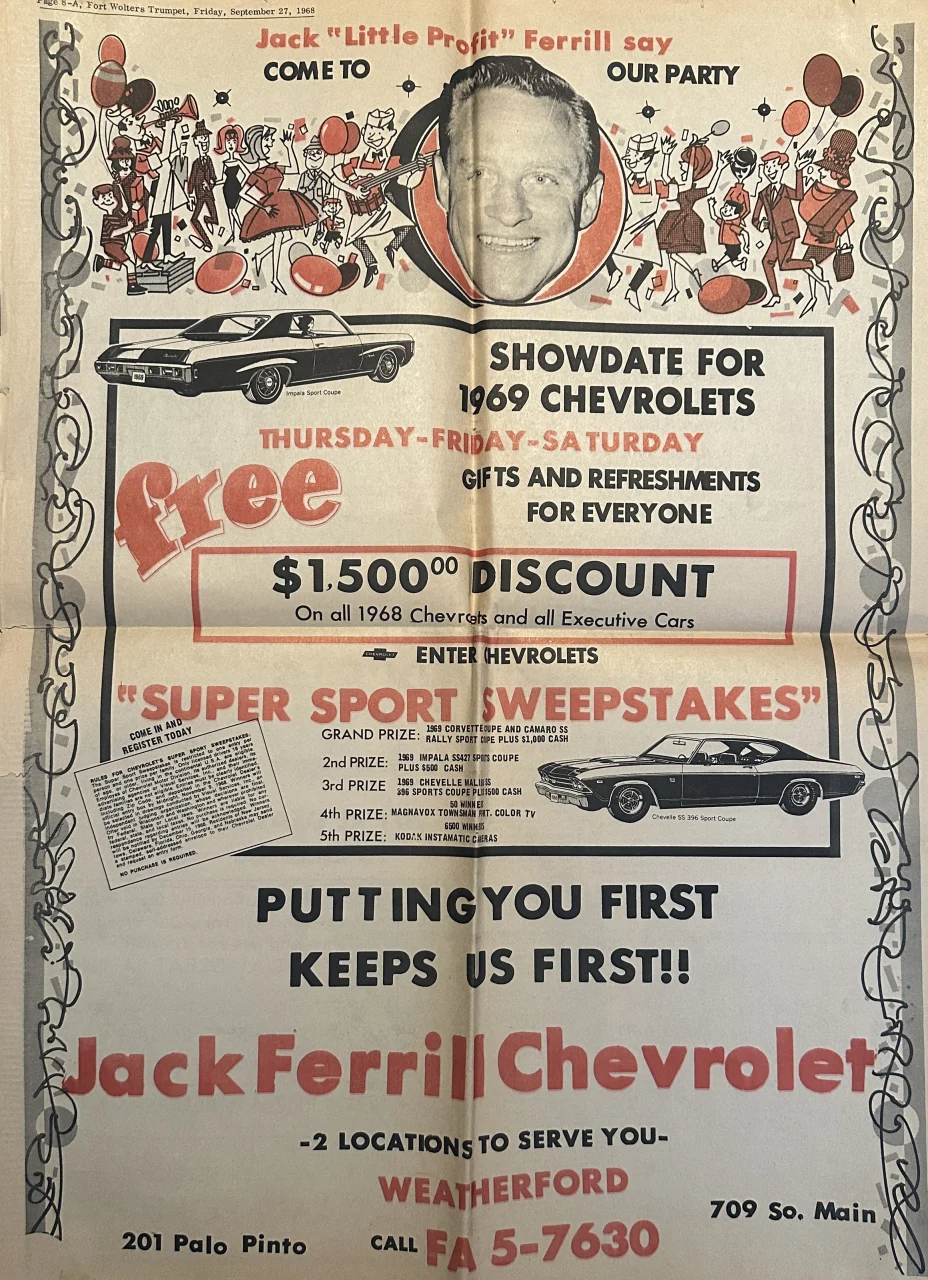
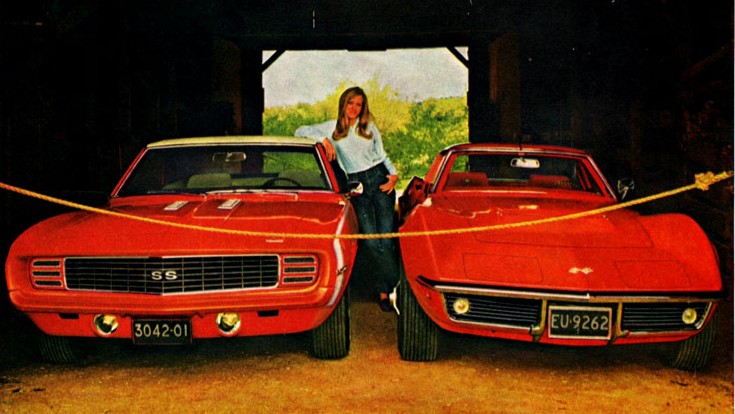
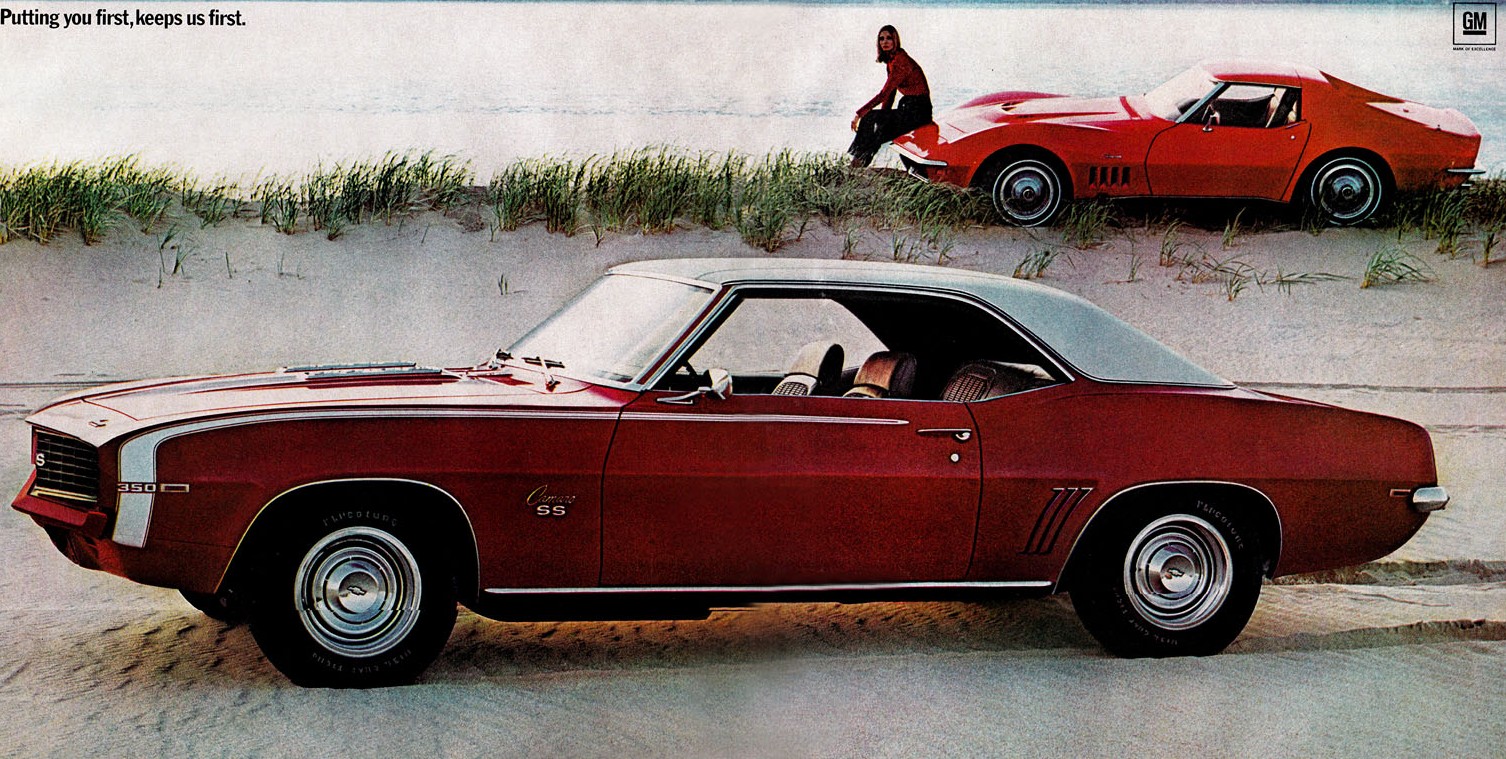
Imagine winning two brand-new cars – a 1969 Chevrolet Camaro and a 1969 Chevrolet Corvette – in a sweepstakes. That was a very real opportunity in late 1968 as a grand prize award at a Texas dealership. While our high-level internal research didn’t uncover the names of those who won the cars, hopefully one of our savvy readers will have information – or at least a recollection.
The inquiry came about because I was reviewing some artifacts left behind by a family member who passed away some years ago. One of them was a yellowed old newspaper – the Fort Wolters Trumpet, dated Friday, September 27, 1968. Jack Ferrill, of Jack Ferrill Chevrolet in Weatherford, about 30 miles west of Fort Worth, had reserved the entire page 8A for an advertisement about the “Super Sport Sweepstakes.” The prizes were laid out as follows:
Grand Prize: 1969 Corvette Coupe + 1969 Camaro SS Rally Sport Coupe + $1,000 cash
2nd Prize: 1969 Impala SS 427 Sports Coupe + $500 cash
3rd Prize: 1969 Chevelle Malibu SS 396 Sports Coupe + $500 cash
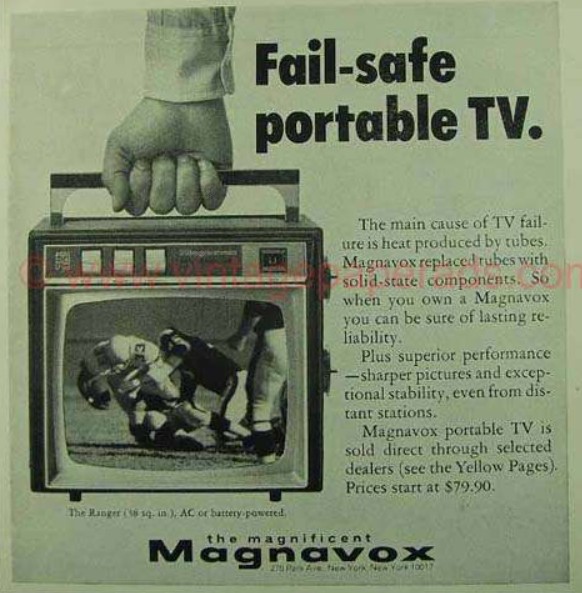
4th Prize (50 Winners): Magnavox Townsman portable color TV
5th Prize (6,500 Winners): Kodak Instamatic Hawkeye R-4 camera
At the time, Ferrill’s dealerships were offering a $1,500 discount on all 1968 Chevrolets – the newer models were landing, after all. The fine print said that entries (for which no purchase was required) were due November 9, 1968, and winners would be notified by December 15, 1968.
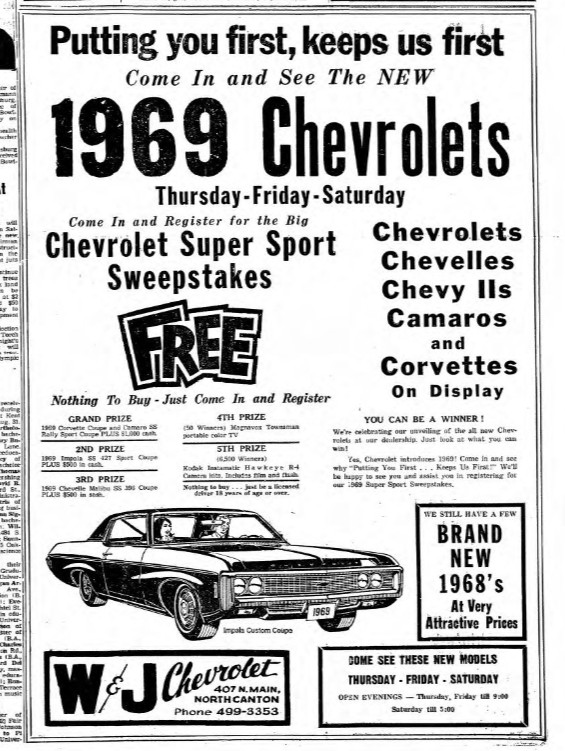
I did find out that other dealerships had the same promotion, so this was a bigger event than just a Jack Ferrill marketing tactic. One was W&J Chevrolet in North Canton, Ohio, which ran an ad in the Sun on September 25, 1968. Another was House Chevrolet Co in Silverton, Texas, which ran an ad in the Briscoe County News on September 19, 1968. They were collectively pushing this promotion pretty hard at various dealerships around the country.
Imagine winning two brand-new cars – a 1969 Chevrolet Camaro and a 1969 Chevrolet Corvette – in a sweepstakes. That was a very real opportunity in late 1968 as a grand prize award at a Texas dealership. While our high-level internal research didn’t uncover the names of those who won the cars, hopefully one of our savvy readers will have information – or at least a recollection.
The inquiry came about because I was reviewing some artifacts left behind by a family member who passed away some years ago. One of them was a yellowed old newspaper – the Fort Wolters Trumpet, dated Friday, September 27, 1968. Jack Ferrill, of Jack Ferrill Chevrolet in Weatherford, about 30 miles west of Fort Worth, had reserved the entire page 8A for an advertisement about the “Super Sport Sweepstakes.” The prizes were laid out as follows:
Grand Prize: 1969 Corvette Coupe + 1969 Camaro SS Rally Sport Coupe + $1,000 cash
2nd Prize: 1969 Impala SS 427 Sports Coupe + $500 cash
3rd Prize: 1969 Chevelle Malibu SS 396 Sports Coupe + $500 cash
4th Prize (50 Winners): Magnavox Townsman portable color TV
5th Prize (6,500 Winners): Kodak Instamatic Hawkeye R-4 camera
At the time, Ferrill’s dealerships were offering a $1,500 discount on all 1968 Chevrolets – the newer models were landing, after all. The fine print said that entries (for which no purchase was required) were due November 9, 1968, and winners would be notified by December 15, 1968.
I did find out that other dealerships had the same promotion, so this was a bigger event than just a Jack Ferrill marketing tactic. One was W&J Chevrolet in North Canton, Ohio, which ran an ad in the Sun on September 25, 1968. Another was House Chevrolet Co in Silverton, Texas, which ran an ad in the Briscoe County News on September 19, 1968. They were collectively pushing this promotion pretty hard at various dealerships around the country.
Being a numbers geek, I had to crunch the values of the prizes at stake. As we would have expected, the cars ranked in values from high to low in order of prize hierarchy. The grand prize winner received about $8,209 worth of vehicles and $1,000 in cash. The Magnavox televisions (quantity of 50) and the Kodak cameras (quantity of 6,500) were big-ticket items at $79 and $40 each respectively. The cameras alone came out to $260,000 in prize winnings.
So, the total? $280,828 in January 1969 dollars, which comes out to $2,530,567 in 2025 dollars.
Yeah, this was a pretty big deal – which makes me wonder if any such giveaway has been attempted prior or since. Incidentally, I did come across a website that mentioned something about Jack Ferrill’s dealership going bankrupt by 1970. Oh, and along the way, I learned that the word Magnavox is Latin for “great voice.” I love these little investigations.
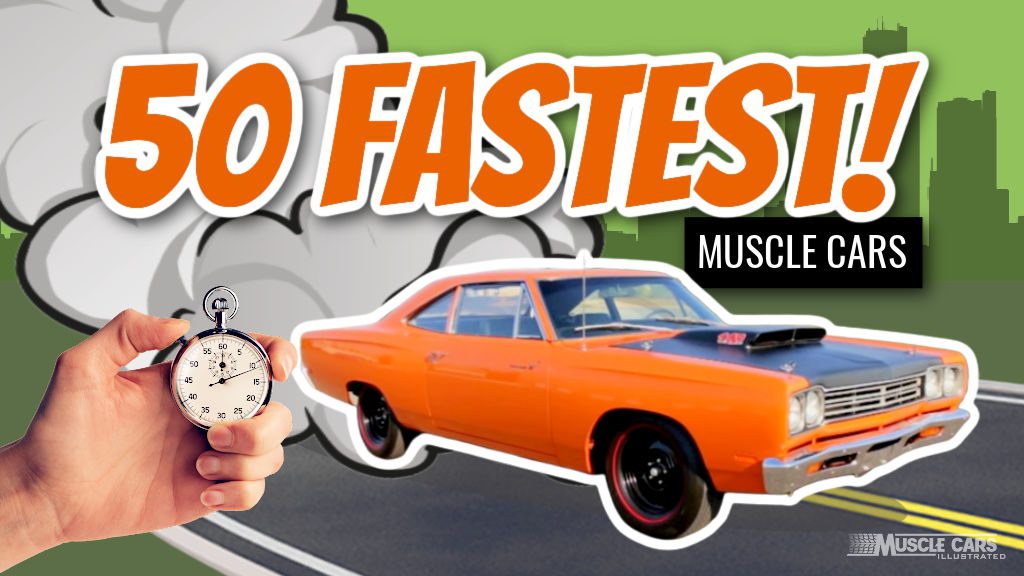
The fastest classic muscle cars made by General Motors, Chrysler, and Ford, starting in the 1960s, were made specifically to address the unquenchable desire for high-performance driving machines from young buyers.
Unsurprisingly, the auto manufacturers wanted to sell a muscle car to each of them. However, they knew to rely on advertising and that word-of-mouth marketing alone wouldn’t cut it.
Not leaving anything to chance, American auto manufacturers knew the best way to move the needle on sales was to get their high-performance supercars into the hands of the car magazines so that intensive road tests could be recorded and published.
Publications such as Motor Trend, Car Craft, Road and Track, Hot Rod, and Car & Driver were the go-to sources to be seen and demonstrate superior performance.
Each publication conducted its road and track tests and published the findings. Various facts, figures, and impressions were collected and published.
The Fastest Classic Muscle Cars Revealed
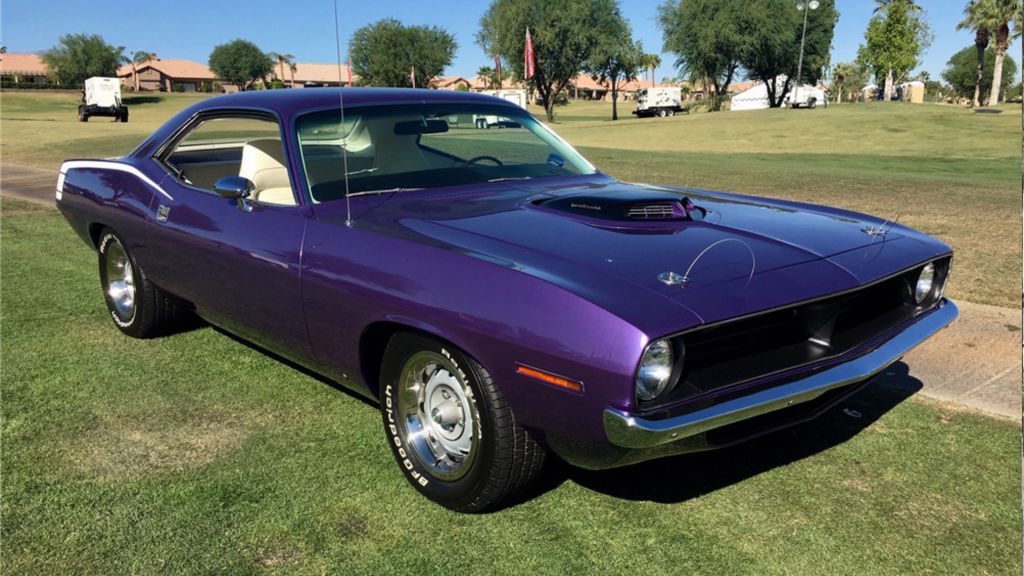
The 1970 Plymouth Hemi Cuda was the fourth fastest on the list but is technically the second-fastest muscle car. Both the Corvette and Shelby Cobra are technically sports cars.
The 1960s and early 1970s were a golden age for American muscle cars. With advances in automotive engineering and design, these classic muscle cars boasted enormous engines, high horsepower, and blistering acceleration that captured the hearts of car enthusiasts and racers alike.
The muscle car era was defined by iconic muscle cars from various manufacturers, each one trying to outdo the other in terms of performance and style. From the legendary 1964 Pontiac GTO to the 1973 Pontiac Trans Am, these classic muscle cars represent the best of American automotive engineering.
In this article, we’ll bring you a definitive list of the top 50 fastest muscle cars from the 60s and 70s. Whether you’re a die-hard muscle car enthusiast or a casual admirer, you will surely find something to love in this list.
We’ll list each car in rank order, including their engines, horsepower, quarter-mile ET times, trap speed, and the sources of the information.
So buckle up and prepare to take a trip down memory lane as we explore the fastest and most powerful classic muscle cars from the golden age of American automotive engineering.
Let’s look at the fastest classic muscle cars rank-ordered by quarter-mile time, shall we?
Top 50 Fastest Classic Muscle Cars
The Top 50 Fastest Classic Muscle Cars list has been a benchmark in the muscle car community since its first publication in November 1991 by Muscle Car Review magazine.
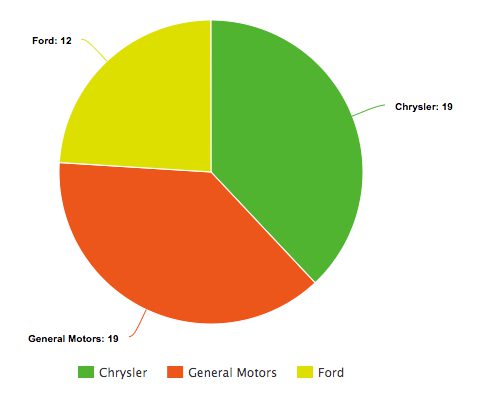
The fastest by auto manufacturer has Chrysler and General Motors tied for first place, each with 19 vehicles on the list. Ford came in second place with 12 vehicles.
Fastest Classic Muscle Cars by Motor Division
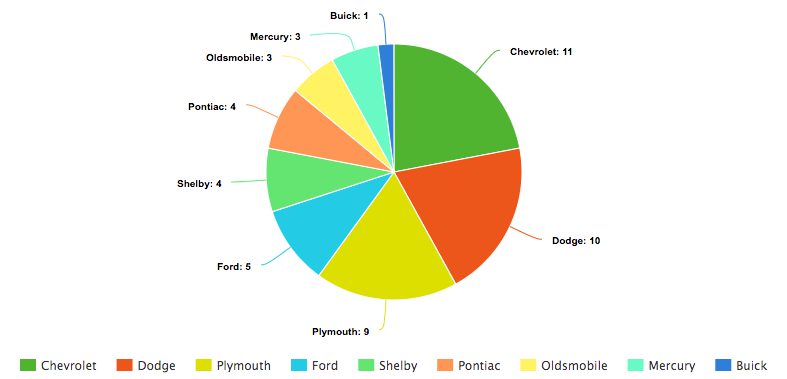
The top three fastest by motor division has Chevrolet in the first place, Dodge in second place, and Plymouth in third place. Ford is in fourth place, Shelby in fifth, Pontiac in sixth, Oldsmobile in seventh, Mercury in eighth, and Buick in ninth place.
Top 10 Fastest Classic Muscle Cars by Motor Division
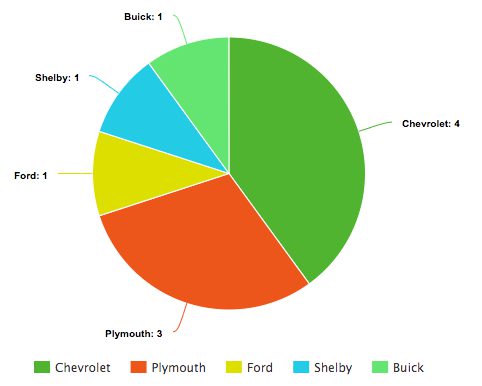
The top fastest cars by motor division has Chevrolet in the first place, Plymouth in second, and Ford, Shelby, and Buick tying for third place.
Fastest Classic Muscle Cars by Year
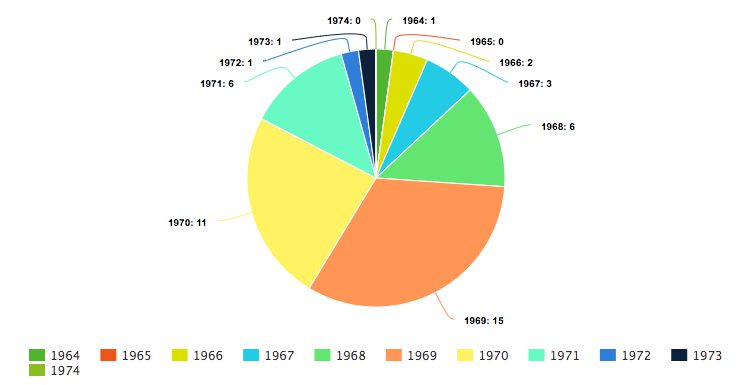
The class of 1969 had the most vehicles on the list, with 1970 coming in second place and 1968 and 1971 tied for third.
Conclusion
The classic muscle cars of the 1960s and early 1970s remain among the most iconic and sought-after vehicles in automotive history.
From the Plymouth Roadrunner’s raw power to the Pontiac GTO’s sleek lines, these cars defined an era of American muscle and continue to inspire car enthusiasts today.
Whether it’s the rumble of a 426 Hemi or the roar of a big block Chevy, these muscle cars are more than just machines—they represent a time when driving was more than just transportation. It was an experience.
This 1974 Chevrolet promotional film, titled ” Selling Corvette “, was sent to the Chevrolet car dealerships to be used as an in-house Sales and customer training film. This film highlights technical aspects and features of the new model year. Model shown includes Corvette sports coupe with T-Tops. Accessories and Features Highlighted include, Anti-theft system, Leather Seats, Tilt and telescope steering wheel, Air Conditioning, 350 LS – 2 and 454 LS – 4 Engines, Posi traction, 4 piston disc brakes, and Dual Exhaust. If you look up a different film I posted, titled “1974 Chevy Selling Monte Carlo “, you can see a rare glimpse of the film cartridge viewer that was used at the dealership where the customers and personnel were to view these films. The machine was made by Technicolor and called the ” Chevrolet Mini Theater System ” This film came from my personal collection.
This film was not downloaded from any website and is not reused content. This restoration is my work. The restoration process started with removing the super8 film from the Technicolor Cartridge. After removal the film was cleaned, repaired, and spooled onto a standard film reel. This film had many scratches and dust marks along with severe color fade. The scanning to digital process and basic color correction was performed on the Lasergraphics Scanstation motion picture film scanner system in 2k resolution. Excess film grain noise was removed and the images upscaled to 4K resolution utilizing Topaz AI software. Then in 4K, extensive color restoration was performed in Davinci Resolve. Scratches and dust marks along with advanced noise removal was performed using NeatVideo. Then a second and final color restoration and image stabilization was performed in DaVinci Resolve. Unfortunately, this film appears to have external sunlight damage causing the color and film image to shift and change as the film progresses. Finally, the film was downscaled back to 2k for uploading to YouTube. As I work on these films, I try to improve the process as I go along. Thanks for watching.
From Reader Jonathan H – So it’s kind of a long story but here goes… I had a Corvette Coupe and I was cleaning the engine compartment one day when I found a metal ID tag on the radiator from a radiator shop in Saginaw Michigan. I called the shop to see if they remembered working on the car and if they knew who the owner was back then. They gave me the owners name and I found his phone number through Google. I called him up to talk to him about the Corvette he used to own and he thought I was calling about another black Corvette, a convertible :). I said what convertible? He said the 435 hp black convertible. Isn’t that the car you are calling on? I said no but I would love to hear about it!
His friend had owned it since the early ’90s and then put it away in climate controlled storage after the gas tank began to leak. It sat there until 2018. I asked him if he would possibly sell the car and he said he wasn’t really interested. So I stayed in touch and months later I called him to check in on the car and surprisingly he said he would be open to selling it.
So I took my son out of school and took my father in law with us to drive up to Michigan to get the car. When I got there it was crazy. The car had layers upon layers of dust on it, the interior was covered with a film of white mold, and there were cobwebs under the hood and on the suspension. It didn’t run so we pushed out into the sunlight and took about an hour to go over the car. Remarkably the car preserved fairly well and was extremely original.
In fact this rare triple black 1969 Convertible still wears some of its original paint, dealer applied factory tough ups, factory original interior, original M-21 Muncie close ratio transmission, original 3:70 Posi-traction rear end, original F-41 suspension and the original numbers matching LR coded engine which has never been out of the car.
It is estimated that less than 900 Tuxedo Black Corvettes were built out of the 38,762 cars that left the St. Louis plant in 1969 due to the poor paint quality on factory black cars. In fact, black was discontinued as a paint color option for the Corvette until the 1977 model year. Making real, original Tuxedo Black cars among the most desirable by Corvette collectors today.
Only 2,722 Corvettes were built with the potent L71 Tri-Power engine option, adding an additional cost of $437 to the sticker price.
When you add the rare L71 435 H.P. Tri-power option, the convertible option, and the Tuxedo Black color option, it is estimated that less than 25 triple black L71 convertibles left the factory in 1969. Which makes this a unique, low production Corvette and one of the only un-restored 1969 black Tri-power convertibles that hasn’t been restored.
A true barn find, this 69 Corvette has been off of the road and in storage for over two decades. Due to a gas leak, the previous owner parked this big block beast in a climate controlled garage until it was found in 2018.
In the fall of 2018, the car was taken to Tim Thorpe, noted 1969 L-88 expert and Bloomington Gold Judge to authenticate the car and get it running again.
The car has just 43k original miles and I have spent a lot of time detailing it and getting back on the road. I am actually amazed at how tight the motor still is and how well it drives.
Future plans are to drive it, show it and share its history with other car enthusiasts (and pass it down to my son someday). What I love most about these old cars is the history. I have been really lucky to have located and spoken to all of the past owners of the car including the original selling dealer who connected me with the original owner. I text and talk regularly with the original owner who ordered the car back in December of 1968. It has been a lot of fun listening to his stories of the car, and look forward to hopefully meeting up with him so he can take it for a spin and open up the three carburetors, just like he did back in ’69……
Let me know if you have any questions. Thanks and have a great New Year!
This race-winning L88 ’67 has touched many lives over the past half century, and engendered many lasting friendships along the way
Story by Richard Prince
Photos by the author
May 11, 2017
As ancient Chinese philosopher Lao-Tzu taught us, every great journey begins with one small step. Our feature car’s great journey began in the fall of 1966 when Clyde Wheeler, Vice President of Public Affairs and Public Relations for the Sunray DX Oil Company, allocated money to expand Sunray’s motorsports-marketing initiative. Sunray would go from sponsoring tracks and events in the Midwest to forming its own racing team. To that end, the company contacted Yenko Chevrolet to order a race-ready ’67 Corvette. They chose a Corvette because of its all-American image and because they wanted to win. They went to Yenko because it was the foremost high-performance Chevy dealership in the country and, perhaps more importantly, because Don Yenko could get them something that was officially unavailable at the time: an L88 Corvette.
RPO L88 was a road-race option package that Chevy offered for Corvettes from 1967-69, but it was not available in September 1966 when 1967 production began. Furthermore, it was not even eligible to race, at least not in FIA-sanctioned events, because the L88 engine was not yet FIA homologated at the time. Sunray wanted to open its ’67 season with the 12 Hours of Sebring, which then as now was the most important sports-car race in America, and perhaps second in importance throughout the world only to Le Mans. To get an L88 built in time for Sebring, some favors would have to be called in, and nobody was in a better position to get the job done than Don Yenko.
The Yenko family had been close with Ed Cole since shortly after Frank Yenko opened his Bentleyville, Pennsylvania Chevy dealership in 1927. Cole was an engineer with GM who shared some key things in common with the Yenkos, including an insatiable interest in aircraft and flying, and a love for high-performance cars. Despite having only a limited education and no engineering degree, Cole progressed steadily through the ranks, serving as head of engineering for Cadillac and then Chevrolet, general manager of Chevrolet and, ultimately, president of General Motors. In 1967 Don Yenko may have been the only Chevy dealer in the world who could telephone the president of GM to ask for a personal favor. He did, and through Cole’s initiative a Central Office Production Order (COPO) was written to build an L88 Corvette for Sunray DX Oil.
As with each of the 216 L88 Corvettes built from 1967-69, the heart of Sunray’s car was a potent 427-cubic-inch engine. Four-bolt main bearing caps anchored a forged, cross-drilled and nitrided crank. Forged steel connecting rods rode on special bearings, and 12.5:1-compression forged aluminum pistons were anchored with full-floating pins. To keep weight down, the engine’s rectangular-port, closed-chamber cylinder heads were cast from aluminum. From heat-treated rocker arms and strengthened springs to oversized valves and a high-lift, long-duration camshaft, the entire valvetrain was optimized for sustained high-speed operation and maximum power.
A small-diameter flywheel and clutch saved valuable reciprocating weight and helped the engine rev up relatively quickly for a 7-liter V-8. Induction came via a single Holley 850-cfm carburetor, perched atop an open-plenum aluminum intake manifold whose design was skewed toward generating peak output in the upper reaches of the rpm band. The carburetor was fed cool outside air courtesy of underhood ductwork that reached back to the high-pressure area at the base of the windshield. Spark came from GM’s reliable transistor ignition system, uniquely tailored for the L88 with heat-resistant Delco plug wires and a distributor without vacuum advance. An oversized aluminum cross-flow radiator delivered extra cooling capacity, and a special heavy-duty Delco starter motor cranked over the big, high-compression mill.
While a thundering 427 engine was the focal point of the L88 package, it was only one part of what turned an ordinary Corvette into a potential race winner. All ’67 L88 Corvettes were built with the M22 heavy-duty four-speed transmission, G81 Positraction differential, J50/J56 heavy-duty power brakes, F41 heavy-duty suspension and K66 transistor ignition. In addition to all of the components that L88 Corvettes had to have, there was also a list of things they could not have, including the otherwise standard heater/defroster system and “luxury” options such as a radio and air conditioning.
Besides the monster motor and the various heavy-duty parts that necessarily accompanied it, Sunray’s ’67 coupe was equipped with a variety of special components provided by Chevrolet Engineering. Among these were a unique header and side-exhaust setup, twin-pin rear brake calipers, light alloy wheels and a 44-gallon fiberglass fuel tank.
On March 9, 1967, Sunray DX’s L88 reached the end of the St. Louis Assembly line, and Tulsa, Oklahoma insurance executive and accomplished racer David Morgan was there to greet it. When Morgan stepped off a Boeing 707 at Lambert Field in St. Louis earlier that day, he had no way to know he was beginning his own great journey with the Sunray DX L88 that would still be going strong more than half a century later. All he was thinking about then was the immediate journey he faced: driving this brand-new, fire-breathing Corvette some 585 miles to Yenko’s facility in Canonsburg, Pennsylvania.
After Morgan got to the dealership, he and Don Yenko posed with the car for some publicity photos. Then it went into Yenko’s race shop, where mechanics Bill Hartley and Warren Dernoshek went through the entire car to make sure it would be as reliable as possible. They also lightened it by removing unnecessary things such as the carpet and most of the other interior trim. The car next went into the paint shop, where Sunray Oil’s signature dark blue was sprayed on the lower half of the body. The upper surfaces retained their factory-applied Ermine white paint, and the original red hood stinger stripe was continued on the roof and down the rear deck.
Three weeks after it was born, Sunray’s all-American red, white and blue L88 carried Yenko and Morgan to an impressive First in class and 10th overall at Sebring. Morgan went on to win the 1967 SCCA Midwest Division Championship with the car.
When 1968 rolled around, Sunray expanded its motorsports program with the addition of two ’68 Corvettes. For the first race of the year, Daytona’s famed 24-hour contest, they entered both of these new cars and the “old” ’67. As lead driver for the team, Morgan chose to drive the ’67, even though it was predicted to be slower than the more aerodynamic C3s. That expectation however, proved false. In terms of aerodynamics, the C2’s biggest problem was front-end lift—Zora Duntov famously observed that above 150 mph, C2s became bad airplanes—but on Daytona’s 33-degree banking lift was not an issue because centrifugal force negated it. Pinned down by this assist from the laws of physics, and aided by numerous special parts provided by Chevrolet Engineering, including a 2.60:1 ratio rear differential, the ’67 DX Corvette reached speeds in excess of 194 mph at Daytona.
Equally important, the car was rock-solid reliable, running perfectly for all 24 hours and spending a total of under 60 minutes in the pits for fuel, tires, brake pads and driver changes. In stark contrast, the new-and-improved ’68 Corvettes experienced a plethora of problems, including severely overheated differentials, that took them out of contention.
Though all three Sunray DX Corvettes took the checkered flag at Daytona, it was “old reliable” that earned the win, carrying Morgan and co-driver Jerry Grant to First in GT and 10th overall. Morgan and others drove the ’67 only sporadically after Daytona because the 1968 Corvettes were in fact faster at most of the tracks where the team raced. In 1969 the entire Sunray DX motorsports program came to an end with the merger of Sunray and Sunoco. Sunoco already had a very successful racing operation, headlined by a fellow named Roger Penske, and they had no need to keep two teams going.
In the fall of 1969 the ’67 Corvette was advertised for sale in Competition Press, and an engineer from central New York named Bob Luebbe bought it. Luebbe, who raced it in SCCA events over the following two years, owned a lot of different race cars both before and after his purchase from Sunray, including Ferraris, Jaguars and a competition Mercedes 300 SL, but he remembers the L88-powered Corvette as the fastest car that he ever drove.
In November of 1970 Luebbe sold the car to fellow engineer and friend Dave Laughlin. It was still painted in Sunray’s red, white and blue color scheme, and it still had the company’s sponsorship stickers on it. Laughlin went to driver’s school in the car, and after he got his competition license he raced it on tracks all over the Northeast.
By the time Laughlin sold the car to Tom Rynone, another racer residing in central New York, its identity had been dramatically transformed. Laughlin had it repainted, and though it was still red, white and blue, it no longer looked like the Sunray DX Corvette.
Rynone raced the car until selling it in 1974 via word of mouth to Long Islander Dave Dempsey. Dempsey was an avid Corvette enthusiast with a growing interest in road racing. He bought the DX coupe and swapped an L71 427 from his ’67 Corvette convertible into it. He continued racing the car for some 16 years, until selling it to your author in 1990.
After 23 uninterrupted years of competition, the car was worn out but complete, with its essentials still intact. Over time it had been hit in every corner, but remarkably it still retained its factory chassis and body tub. The original roll bar was there, complete with its unique SCCA-assigned serial number. Also still intact were a number of its special parts, including offset rear trailing arms, heavy-duty brakes with twin-pin rear calipers, dry-sump system provisions and the original Harrison engine-oil cooler. And sitting in the glove box was another special part: the original SCCA logbook, documenting the car’s history.
With invaluable help from friends, my wife and I performed a body-off-the-frame restoration that returned the Sunray DX L88 to its 1967 Sebring configuration. We also spent thousands of hours tracking down everyone and everything that had any connection to the Sunray DX motorsports program. Following restoration, we displayed the car in the Bloomington Gold Special Collection and in various motorsport retrospectives put together by Chevrolet; took it back to Canonsburg for a reunion of Yenko family members, employees and friends; and displayed it at the Chevrolet Engineering Center in Michigan.
We also occasionally put this remarkable Corvette back on track. One highlight was a race on the high banks of Daytona by none other than Dave Morgan, the very same Dave Morgan who picked it up at the factory when it was new and went on to drive it to glory at Sebring, Daytona and elsewhere. Never shy in exercising his sense of humor, Morgan had this to say just prior to his drive: “You don’t have to worry about me hitting anything out there if the brakes fail. I’ll just do what we always did at Daytona when we ran out of brakes—scrape it along the wall to slow it down.”
Another high point came in the Pittsburgh Vintage Grand Prix when “The Flying Dentist,” Dr. Dick Thompson, piloted the car. That experience had its humorous moments as well, especially after I went through a methodical description of all of the car’s features and characteristics. Dr. Thompson was extremely attentive and listened very patiently as I droned on. When I finally finished, one the greatest racers in Corvette history looked me straight in the eye and said, “You don’t have to worry about a thing, son. I’ve done this once or twice before.”
Several years ago we passed this special Corvette along to its next caretaker, longtime friend and avid Corvette collector Glen Spielberg. Over a period of about two years, Spielberg performed the car’s second comprehensive restoration, bringing it to a new level of perfection. Following completion, it was unveiled at the prestigious Amelia Island Concours in Florida, where it received a special award presented by GM design chief Ed Welburn. Following Amelia, it was displayed in the Sebring Hall of Fame. The highlights of Amelia and Sebring, for both Spielberg and your author, was seeing David Morgan and the car brought together yet again. Not surprisingly, the reunion was also a highlight for Morgan and his wife, Marlene.
“I love this Corvette,” he reflected, “but not just because it carried me to some great wins. I love it because of the great friendships it has engendered. For more than 50 years it has brought some truly wonderful people into my life and led to many lasting friendships. That’s not something I could have imagined when I picked this car up at the factory, and that, above all else, is what I cherish most most about it.”
“I love this Corvette,” he reflected, “but not just because it carried me to some great wins. I love it because of the great friendships it has engendered. For more than 50 years it has brought some truly wonderful people into my life and led to many lasting friendships. That’s not something I could have imagined when I picked this car up at the factory, and that, above all else, is what I cherish most about it.”
Sidebar: Deceptive Advertising: Marketing the L88
A 1967 L88 tuned to the razor’s edge and running through open exhaust produces about 560 horsepower at 6,400 rpm. Nonetheless, Chevrolet quoted the optional engine’s output at 430 hp at 5,400 rpm, well before the power curve peaked. Most buyers in search of the ultimate performance Corvette thus skipped straight to the 435-horse Tri-Power L71 on the order sheet, which is exactly what Chevy wanted. Why? Because the race-spec L88 engine was, in just about every respect, completely unsuitable for street driving. Intentionally under-quoting power output was just one way that Chevy tried to keep L88s off public roads. Another cagey maneuver entailed pricing the option out of reach of the average Corvette customer. The engine alone cost an eye-popping $947.90, more than double the price of the allegedly more powerful L71. Selecting RPO L88 also required the addition of several mandatory options, including the M22 heavy-duty four-speed ($237.00), G81 Positraction differential ($42.15), J50/J56 heavy-duty power brakes ($384.45), F41 heavy-duty suspension ($36.90) and K66 transistor ignition ($73.75). If the pessimistic output rating and swollen price weren’t enough to put off L88 intenders, the list of items that could not be had with an L88 usually was. The ordinarily standard heater/defroster system and options such as a radio and air conditioning were verboten. The carburetor did not have a choke, and the radiator did not have a fan shroud. (Why? Race engines typically don’t need to start on cold winter mornings, and airflow over the radiator tends to be more than adequate at triple-digit speeds.) The final deterrent to buying an L88 was its fuel requirement. The high-compression beast had to be fed gasoline with a research octane number of at least 103, or serious engine damage could result. Even in the allegedly “good old days,” this fuel was both uncommon and expensive. For all of these reasons, street-driven L88 Corvettes were vanishingly rare in the late ’60s, just as Chevy intended.
Decades of disuse, followed by a functional freshening, helped keep this lightly optioned Split-Window in extraordinary, original condition.
Story by Richard Prince
Photos by the author / November 4, 2021 Every vintage Corvette has a story to tell, but some are far more interesting than others. This 1963 coupe’s odyssey began on July 11 of that year, when it rolled out of Chevrolet’s sprawling assembly complex at 3801 Natural Bridge Avenue in St. Louis. There was nothing remarkable about the car itself—power came from the base 327/250-horse engine coupled with a wide-ratio four-speed transmission and an open, 3.36:1-ratio differential. The only options installed, in addition to the M20 gearbox, were an AM/FM radio and whitewall tires.
There was, however, something very unusual about the man who bought the car from Lustine Chevrolet, a dealership located in the Washington, D.C. suburb of Hyattsville, Maryland. Richard F. Burke was employed by the Central Intelligence Agency, and his work, which remains shrouded in secrecy to this day, took him all over the world. As a result Burke’s Corvette was rarely driven while he owned it, instead remaining in storage most of the time inside his parents’ garage on Pennsylvania Street in Hyattsville.
While overseas late in 1966, Burke saw—and oddly enough, fell in love with—a Saab 96, the Swedish company’s quirky, two-door sedan that was manufactured from 1960 through 1980. Though very few clear-thinking individuals could possibly have preferred the Saab’s odd styling and 72-horse three-cylinder to the iconic “Split-Window” ’63 Corvette and its brawny V-8, Burke pulled the trigger and bought himself one.
Richard’s brother Robert, who was also a CIA officer, jumped at the chance to buy the Corvette, which at the time was still in virtually new condition. He paid Richard $4,000 for the car, which originally came with an MSRP of $4,651.20. Within three years of selling the Vette, Richard Burke became very ill, reportedly as a result of being poisoned while in Southeast Asia. Shortly after returning to the United States, he died.
Over the ensuing decades Robert Burke drove the Corvette very sparingly, using it for pleasure exclusively while retaining a sequence of more mundane cars, starting with a 1956 Pontiac, for daily transportation. The Corvette always went back to Lustine Chevrolet for routine service and any needed repairs, and Burke was very careful to preserve its originality to the extent feasible. As he aged, Burke drove the car less and less, adding only about 6,000 of its 41,000 total miles between 1970 and 2016, when he passed away at the age of 89.
According to family members, Burke intended to leave his beloved Corvette to a favorite nephew who had shown great interest in it, but after his passing no will could be found. Absent that, his entire estate, including his Silver Blue Split-Window, went to numerous heirs, and to achieve a statutorily mandated equitable distribution, the estate had to sell the car.
Meanwhile, exactly 222 miles north of the garage at 3411 Pennsylvania Street where the car had lived its entire life, well-known Corvette restorer Chris Tucci and his business partner Quentin Carbone were displaying several beautifully revitalized old Vettes at the New York Auto Show. Toward the end of the show, two middle-aged couples approached the restoration duo. After asking some questions, one of the women revealed that her uncle had passed away in Maryland and that his old Corvette would have to be sold at some point in the future. The couple did not know much about the car, but the woman did mention that there was something special about its rear window, which of course got Tucci and Carbone’s attention. They exchanged phone numbers and promised to stay in touch.
Tucci and Carbone checked in with the woman regularly over the following year, but because the probate process was not completed, the car couldn’t be sold. Then, on June 19, 2017, the call the pair had been waiting for finally came. Owing to the level of interest in the Corvette among others, they had to move quickly. Together with Chris’ cousin Joe Cantalino, who was brought in as a third partner in the purchase, the men flew to D.C. and met the cousin handling the sale on behalf of the estate.
After a somewhat lengthy search for the keys to the garage and car, they raised the door and finally saw the Corvette they had been chasing over the previous year. It was dirty and sad looking, with flaking paint, flat-spotted tires, and cobwebs stretching from various points on the chassis down to the floor. But at the same time it was exactly what every vintage-Corvette enthusiast dreams of finding.
“One look and I immediately fell in love with the car,” recounts Cantalino. “My Uncle John—Chris’ father—bought a red Split-Window Coupe brand new when I was only two years old, and today Chris still has it. Our families lived next to each other in a two-family home in Brooklyn, and I grew up with that car.
“Uncle John would take me, my brother Tony, and my cousin Elisa for rides, and we would fight to sit in the back under the split rear window, looking ahead to the aircraft-like gauges. This was burned into my mind growing up and made me always want a ’63 of my own to enjoy.”
Though the Burke car potentially furnished Cantalino with an incredibly original ’63 coupe that was available to buy, there were two big hurdles to overcome. The first was that the car needed to be painted. But while it would have been a simple matter for Tucci to re-spray it in its original color, the restorer recommended a different approach.
“He responded that the paint wasn’t a problem in spite of its rough condition because it was original, and as a genuine ‘survivor,’ it should never be repainted,” Cantalino says. “I understood that, but there was still another problem, which was that I didn’t want to resell the car as we originally planned. I wanted to keep it, [so I] offered my partners compensation.”
The pair agreed, and Cantalino offered to pay the estate’s asking price. “I wire-transferred the money immediately, and my wife Carmela called, asking why I was paying the entire amount when I had two partners,” he says. “I explained that having partners can be problematic, [but] now I owned the investment outright and controlled its destiny. Being an intelligent investor, she understood and agreed.”
After getting home, Cantalino arranged to have the car shipped directly to Tucci’s restoration shop on Cortland Street in Lindenhurst, New York. Though he intended to heed his cousin’s sage advice and preserve the car’s remarkable originality, it did need a fair amount of work after sitting with little-to-no use for many years.
Story by Richard Prince
Photos by the author
November 4, 2021
Every vintage Corvette has a story to tell, but some are far more interesting than others. This 1963 coupe’s odyssey began on July 11 of that year, when it rolled out of Chevrolet’s sprawling assembly complex at 3801 Natural Bridge Avenue in St. Louis. There was nothing remarkable about the car itself—power came from the base 327/250-horse engine coupled with a wide-ratio four-speed transmission and an open, 3.36:1-ratio differential. The only options installed, in addition to the M20 gearbox, were an AM/FM radio and whitewall tires.
There was, however, something very unusual about the man who bought the car from Lustine Chevrolet, a dealership located in the Washington, D.C. suburb of Hyattsville, Maryland. Richard F. Burke was employed by the Central Intelligence Agency, and his work, which remains shrouded in secrecy to this day, took him all over the world. As a result Burke’s Corvette was rarely driven while he owned it, instead remaining in storage most of the time inside his parents’ garage on Pennsylvania Street in Hyattsville.
While overseas late in 1966, Burke saw—and oddly enough, fell in love with—a Saab 96, the Swedish company’s quirky, two-door sedan that was manufactured from 1960 through 1980. Though very few clear-thinking individuals could possibly have preferred the Saab’s odd styling and 72-horse three-cylinder to the iconic “Split-Window” ’63 Corvette and its brawny V-8, Burke pulled the trigger and bought himself one.
Richard’s brother Robert, who was also a CIA officer, jumped at the chance to buy the Corvette, which at the time was still in virtually new condition. He paid Richard $4,000 for the car, which originally came with an MSRP of $4,651.20. Within three years of selling the Vette, Richard Burke became very ill, reportedly as a result of being poisoned while in Southeast Asia. Shortly after returning to the United States, he died.
Over the ensuing decades Robert Burke drove the Corvette very sparingly, using it for pleasure exclusively while retaining a sequence of more mundane cars, starting with a 1956 Pontiac, for daily transportation. The Corvette always went back to Lustine Chevrolet for routine service and any needed repairs, and Burke was very careful to preserve its originality to the extent feasible. As he aged, Burke drove the car less and less, adding only about 6,000 of its 41,000 total miles between 1970 and 2016, when he passed away at the age of 89.
According to family members, Burke intended to leave his beloved Corvette to a favorite nephew who had shown great interest in it, but after his passing no will could be found. Absent that, his entire estate, including his Silver Blue Split-Window, went to numerous heirs, and to achieve a statutorily mandated equitable distribution, the estate had to sell the car.
Meanwhile, exactly 222 miles north of the garage at 3411 Pennsylvania Street where the car had lived its entire life, well-known Corvette restorer Chris Tucci and his business partner Quentin Carbone were displaying several beautifully revitalized old Vettes at the New York Auto Show. Toward the end of the show, two middle-aged couples approached the restoration duo. After asking some questions, one of the women revealed that her uncle had passed away in Maryland and that his old Corvette would have to be sold at some point in the future. The couple did not know much about the car, but the woman did mention that there was something special about its rear window, which of course got Tucci and Carbone’s attention. They exchanged phone numbers and promised to stay in touch.
Tucci and Carbone checked in with the woman regularly over the following year, but because the probate process was not completed, the car couldn’t be sold. Then, on June 19, 2017, the call the pair had been waiting for finally came. Owing to the level of interest in the Corvette among others, they had to move quickly. Together with Chris’ cousin Joe Cantalino, who was brought in as a third partner in the purchase, the men flew to D.C. and met the cousin handling the sale on behalf of the estate.
After a somewhat lengthy search for the keys to the garage and car, they raised the door and finally saw the Corvette they had been chasing over the previous year. It was dirty and sad looking, with flaking paint, flat-spotted tires, and cobwebs stretching from various points on the chassis down to the floor. But at the same time it was exactly what every vintage-Corvette enthusiast dreams of finding.
“One look and I immediately fell in love with the car,” recounts Cantalino. “My Uncle John—Chris’ father—bought a red Split-Window Coupe brand new when I was only two years old, and today Chris still has it. Our families lived next to each other in a two-family home in Brooklyn, and I grew up with that car.
“Uncle John would take me, my brother Tony, and my cousin Elisa for rides, and we would fight to sit in the back under the split rear window, looking ahead to the aircraft-like gauges. This was burned into my mind growing up and made me always want a ’63 of my own to enjoy.”
Though the Burke car potentially furnished Cantalino with an incredibly original ’63 coupe that was available to buy, there were two big hurdles to overcome. The first was that the car needed to be painted. But while it would have been a simple matter for Tucci to re-spray it in its original color, the restorer recommended a different approach.
“He responded that the paint wasn’t a problem in spite of its rough condition because it was original, and as a genuine ‘survivor,’ it should never be repainted,” Cantalino says. “I understood that, but there was still another problem, which was that I didn’t want to resell the car as we originally planned. I wanted to keep it, [so I] offered my partners compensation.”
The pair agreed, and Cantalino offered to pay the estate’s asking price. “I wire-transferred the money immediately, and my wife Carmela called, asking why I was paying the entire amount when I had two partners,” he says. “I explained that having partners can be problematic, [but] now I owned the investment outright and controlled its destiny. Being an intelligent investor, she understood and agreed.”
After getting home, Cantalino arranged to have the car shipped directly to Tucci’s restoration shop on Cortland Street in Lindenhurst, New York. Though he intended to heed his cousin’s sage advice and preserve the car’s remarkable originality, it did need a fair amount of work after sitting with little-to-no use for many years.
New reproduction whitewall tires replaced the decades-old rubber that was on the car; the cooling system was drained, flushed, and refilled; and the engine, transmission, and differential oils were changed. With Tucci’s expert guidance, Cantalino restored the fuel and brake systems, rebuilding and retaining nearly all of the original components, including even the rubber brake hoses, which miraculously remained in good condition. Cantalino also went through the clock and all of the gauges to ensure they functioned accurately while still retaining their original appearance. After all the work was completed, the Corvette was back on the road, running and driving like a well-preserved 1963 should.
Cantalino also did the best that he could with the car’s cosmetics. Time was not kind to the lacquer paint applied in St. Louis, but he improved it by carefully cleaning every inch and applying high-quality wax to help rejuvenate and preserve what remains. He also gave the completely original interior, which remains in excellent condition, a deep cleaning.
After getting the car fully functional and looking good again, there was one more problem to address. “The original selling dealer undercoated the car,” reveals Cantalino. “That was a pretty common thing for dealers to do back in those days, especially on the East Coast where roads are salted in the winter. It’s ironic that this car got undercoated even though it was never driven in bad weather, and it turned out to be both a nightmare and a blessing for me. The nightmare was that carefully removing all of the undercoating was a filthy, time-consuming job, but the blessing was that it had preserved the chassis and suspension in like-new condition.
“The year I spent working on the car with Chris in his shop was a great bonding time for us,” he continues. “We spoke often about Chris’ dad, my Uncle John, who owned his beloved, 340-horsepower Split-Window until he passed away. He was a very kind man, and it was wonderful growing up with him. We all owe our love of cars in general, and Corvettes in particular, to Uncle John.”
Since the rehabilitation of Cantalino’s ’63 coupe was completed, he has shared this beautiful original with others at local and national shows, where it has accumulated many accolades. These include a National Corvette Restorers Society (NCRS) Top Flight, Bloomington Gold Survivor, Muscle Car & Corvette Nationals Triple Diamond Certification, Americana Concours Best Preservation, and Coney Island Mermaid Parade Best Original Car award. He’s also gotten a great deal of pleasure from driving the car, adding nearly 2,000 miles to it over the past four years.
Quentin Carbone lusted after this ’67 L71 coupe for years. In the end, he got far more than just the car.
Story by Richard Prince
Photos by the author / February 9, 2017
About 20 years ago Quentin Carbone was starting his construction business in New York City. He needed a subcontractor who was excellent at building and renovating storefronts, and his father recommended a friend by the name of John Tara. Carbone and Tara did end up doing business with one another, and out of that grew a friendship, strengthened in large measure by their mutual love for vintage cars. Tara had a fairly substantial collection that included a few Corvettes, and Carbone was well on his way to becoming a self-described Corvette fanatic himself.
“I had a 1968 convertible that I purchased in 1986,” he remembers. “I really enjoyed driving the car, but it sat in the garage a lot because it wasn’t very reliable.” The lightly modified C3 was “gorgeous,” according to Carbone, thanks to its candy-apple red paint, Centerline rims, white top and chromed-out LT-1 engine. “I loved it, but I started to realize that getting a stock…Corvette may be a better way to go.”
At the time Carbone was driving a black-on-black ’89 convertible with a six-speed, and while he describes that C4 as “a lot of fun,” the allure of another classic model was too strong to resist. “I wanted an old one that was reliable and that I could drive without worrying,” he says.
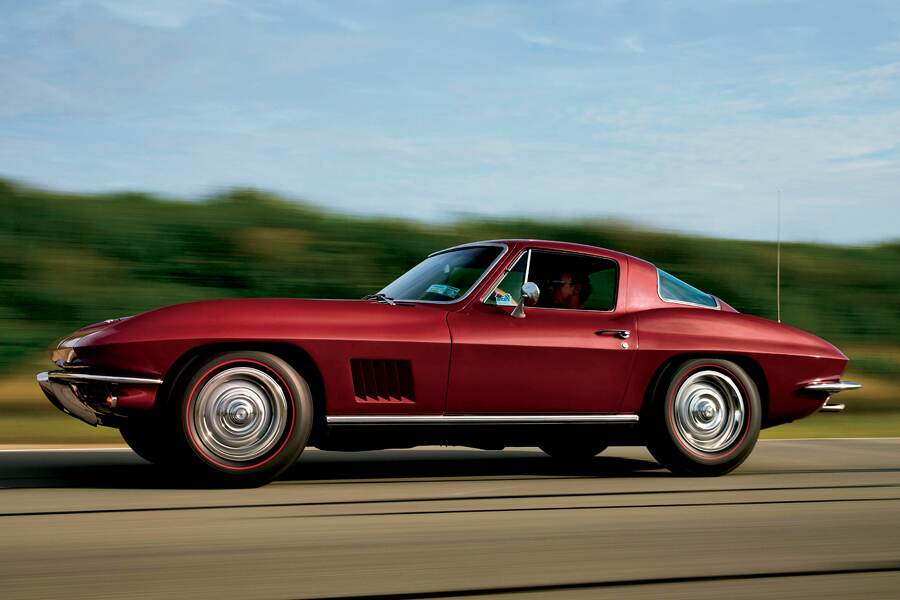
Tara took notice of Carbone’s increasing appreciation for vintage Corvettes and began showing him photos of some of the cars in his collection. “One day he showed me a photo of a 1967 big-block coupe parked right in front of Rockefeller Center,” recalls Carbone. “It was Marlboro Maroon with a black hood ‘stinger,’ and I was instantly hooked on that particular car, so my begging and groveling began.”
To the dismay of Carbone, Tara didn’t want to sell the ’67. Making matters worse in a way, it was an original L71 427/435 car, and by the late 1980s the value of original ’67 435-horsepower Vettes had skyrocketed to the point that Carbone didn’t think he could afford it even if Tara were willing to sell. Still, he didn’t permit that minor inconvenience to dissuade him from frequently reminding Tara he was interested in buying the car. This went on for years, and though Carbone eventually resigned himself to the likelihood that his friend would never sell, he didn’t stop asking. Then one day the phone rang, and all of his tenacity paid off.
“Unbelievably to me, one day in 1996 John decided to let go of a couple of his cars, and he was kind enough to offer me the 1967 before he brought it to market,” Carbone relates. “The only [question] was, how could I afford it? I haggled with him for days over the price, eventually convincing him that his lack of paperwork for the car negatively impacted its value. So I ended up buying it at a very discounted price, which I was able to afford after selling my ’68.”
Story by Richard Prince
Photos by the author
February 9, 2017
About 20 years ago Quentin Carbone was starting his construction business in New York City. He needed a subcontractor who was excellent at building and renovating storefronts, and his father recommended a friend by the name of John Tara. Carbone and Tara did end up doing business with one another, and out of that grew a friendship, strengthened in large measure by their mutual love for vintage cars. Tara had a fairly substantial collection that included a few Corvettes, and Carbone was well on his way to becoming a self-described Corvette fanatic himself.
“I had a 1968 convertible that I purchased in 1986,” he remembers. “I really enjoyed driving the car, but it sat in the garage a lot because it wasn’t very reliable.” The lightly modified C3 was “gorgeous,” according to Carbone, thanks to its candy-apple red paint, Centerline rims, white top and chromed-out LT-1 engine. “I loved it, but I started to realize that getting a stock…Corvette may be a better way to go.”
At the time Carbone was driving a black-on-black ’89 convertible with a six-speed, and while he describes that C4 as “a lot of fun,” the allure of another classic model was too strong to resist. “I wanted an old one that was reliable and that I could drive without worrying,” he says.
Tara took notice of Carbone’s increasing appreciation for vintage Corvettes and began showing him photos of some of the cars in his collection. “One day he showed me a photo of a 1967 big-block coupe parked right in front of Rockefeller Center,” recalls Carbone. “It was Marlboro Maroon with a black hood ‘stinger,’ and I was instantly hooked on that particular car, so my begging and groveling began.”
To the dismay of Carbone, Tara didn’t want to sell the ’67. Making matters worse in a way, it was an original L71 427/435 car, and by the late 1980s the value of original ’67 435-horsepower Vettes had skyrocketed to the point that Carbone didn’t think he could afford it even if Tara were willing to sell. Still, he didn’t permit that minor inconvenience to dissuade him from frequently reminding Tara he was interested in buying the car. This went on for years, and though Carbone eventually resigned himself to the likelihood that his friend would never sell, he didn’t stop asking. Then one day the phone rang, and all of his tenacity paid off.
“Unbelievably to me, one day in 1996 John decided to let go of a couple of his cars, and he was kind enough to offer me the 1967 before he brought it to market,” Carbone relates. “The only [question] was, how could I afford it? I haggled with him for days over the price, eventually convincing him that his lack of paperwork for the car negatively impacted its value. So I ended up buying it at a very discounted price, which I was able to afford after selling my ’68.”
The “very discounted” price reflected the fact that there appeared to be no documentation accompanying the sale, a major impediment to establishing the value of any old Corvette with highly desirable options such the Tri-Power 427. But as it turned out, that documentation was actually right there under Carbone’s nose—he just needed to look for it. Not long after he got home with the car, he located the original owner’s manual and Protect-O-Plate, still in their original plastic bag, stashed underneath the passenger’s seat. At which point he received another pleasant surprise.
“The very next day…John called to tell me he found a folder for the car that he had forgotten about in his file cabinet. It had loads of great stuff, including service receipts, the first transfer of ownership from the original owner to the second owner and an original dealer invoice from Malcolm Konner Chevrolet, signed by Malcolm himself.”
All of a sudden, the ’67 435 with no paperwork had quite a lot of paperwork, which of course increased its value significantly, a fact that weighed heavily on Carbone. “I realized the deal John gave me was too good, and because he is my friend I wanted to remedy that,” he says. “I had no more money to offer him, so I gave him my prized set of American Flyer Standard gauge trains in their original boxes from the late 1920s. They were very rare and valuable, but I knew that John priced and sold his car to me based on him having no documentation, when in reality he had loads.”
After Carbone received the files tracing his Corvette all the way back to its selling dealer, his interest in the car’s history intensified. He learned that Tara had purchased it at a Corvette show at Malcolm Konner in 1981, where he and his friend Vinny Pasquale met a show judge named Don Nicida. Nicida had several cars on display, including the ’67 Tri-Power coupe and two small-block convertibles that really caught Tara’s eye. Tara specifically wanted a convertible and was ready to buy one of them, but his pal Pasquale convinced him to buy the maroon big-block car instead. He agreed, even though it was a hardtop.
Tara owned the car 15 years and shared a lot of information with Carbone, including one particularly memorable story. “One day, on a routine outing with his Corvette, he stopped in at the Tony Nero Hair Salon in Maspeth, Queens for a haircut. While Tony was cutting he casually asked John, ‘Who’s that waiting in your car for you?’ John jumped up out of the chair, knowing he’d left the keys in the ignition and [that] whoever was in the car was up to no good. Sure enough, the ’67 took off.”
Tara and his barber tried running after the car, but of course couldn’t keep pace with it. Luckily, an NYPD patrol car happened upon the scene, at which point the policemen recognized what was happening and gave chase. The young man who’d helped himself to Tara’s Corvette ran up onto a sidewalk and hit some plastic garbage cans before coming to a stop and getting cornered by the cops.
“The whole thing didn’t sit well with the police,” Carbone explains, “and back then it really wasn’t the smartest thing to resist arrest after a high-speed chase in New York City. By the time John arrived at the scene, he saw that the fender was scuffed up from the garbage cans, and he also noticed that there was blood splattered on the car’s hood. He was so upset he drove the car home and parked it in his garage, planning to bring it to a body shop at some point to see if they could clean up the mess. Unfortunately, what would have likely been only a paint repair to one fender turned into a complete re-spray when they realized that every little splash of blood had ended up eating through the paint.”
What made the repaint a little more painful for Carbone was the fact that the car was extraordinarily original in every other respect when he bought it. It had traveled fewer than 40,000 miles since new, and still had a completely original interior and engine compartment. It even had its original hoses, belts, F41 Special Front and Rear Suspension shocks and N11 Off Road Exhaust system.
In the 20-plus years Carbone has owned this beautiful Corvette, he’s shown it several times, earning many trophies as well as two NCRS Top Flight awards, with the first coming in 2001 and the second in 2015. To help maintain the car’s stunning original condition, and keep everything working as it should, he drives it with some regularity. He also relies on the crew at Benchmark Corvettes—a Lindenhurst, New York, firm specializing in Corvette restoration, repair and performance modification—to help keep the car in working order. Carbone’s love for the marque even led him to partner in the business with renowned Corvette expert Chris Tucci, who has more than 30 years of experience restoring many NCRS Top Flight and Bloomington Gold award winners. Tucci has also built some of the baddest hot-rod and restomod cars around.
Carbone gets as much enjoyment from his prized 435-hp Corvette today as he did 20 years ago, and he’s forever grateful to his friend and business associate John Tara for selling it to him. He’s also indebted to Tara for something else. “I’ve remained close to John for all these years, as we really have a lot in common. Besides our work in the construction industry and our love for classic cars…his daughter, Shannon, became my wife about 10 years ago.” Then he adds, laughing, “I guess you could say that I traded him a 1967 Corvette for a couple of grandkids!”
John Valvo’s ’63 coupe has excelled in many roles—including that of presidential “limo”—in its lifetime
Story by Richard Prince
Photos by the author / March 31, 2016
Individuals at the highest levels of American government are almost invariably chauffeured by members of their security detail, so they can go years without driving a car themselves. Several former presidents have cited the relinquishment of their driving privileges as one of the most difficult adjustments they had to make in the name of security, making any time they could sneak in behind the wheel a genuine treat. And when the car the leader of the free world gets an opportunity to pilot just happens to be a 1963 Corvette, the experience goes far beyond a chance to regain a little snippet of normalcy. If you don’t believe me, just ask President Barack Obama, who described his chance to drive John Valvo’s ’63 split-window coupe as a “childhood dream.”
Valvo’s involvement with this now-famous split-window coupe began in the early 1980s, when the newly minted engineer was buying and selling Corvettes for fun and profit. The hobby was experiencing very strong growth in that time frame, and as a result Corvettes were quickly increasing in value. Valvo loved the cars and appreciated the opportunity to earn a few shekels trading in them.
In 1985 he bought a Silver Blue 1963 coupe that was very original but deteriorated. The plan was to repaint the body, freshen up the interior and engine compartment, and then sell it and move on to the next one. Once he stripped off the car’s finish, however, Valvo changed his mind. “After removing the original paint, I saw that the body was extremely straight and all original, so I opted to keep the car instead of selling it,” he says.
Valvo had his new acquisition re-sprayed in its original Silver Blue hue, fixed a few minor things and drove the car sparingly over the next few years. In 1988, after moving back to New York, he had the space and time to perform a rebuild on the 300-hp 327 engine. But once the powertrain was out of the car, Valvo saw other things that needed attention, so in the interest of efficiency, he decided to expand the project. As often happens, one thing quickly led to another, then another, and in the blink of an eye virtually the entire car was apart. “The engine rebuild evolved into a front-suspension removal and rebuild,” he explains, “then it made sense to also remove and rebuild the rear suspension. And finally, I justified to myself that it would be easier to put it all back together if I took the body off the frame.”
By early 1990 the Corvette was reassembled and back on the road. It was a two-year process full of the usual highs and lows, with plenty of scraped knuckles and long nights, but more than enough personal satisfaction and feelings of accomplishment to make it worthwhile. The joy of a job well done was amplified exponentially as Valvo used the car for occasions large and small in subsequent years. “There were, of course, lots of car shows and lots of awards,” he recounts, “and I made a lot of lasting friendships through my involvement with the hobby, and had a lot of fun. For example, [one] Christmas Eve the Corvette was used for making my rounds in a Santa Claus suit. I can’t tell you the expressions on people’s faces as they first noticed the car and then noticed that Santa was driving it. In 1994 I drove the car to the church for our wedding and used it for our ‘getaway’ after the reception. And thankfully, we were able to buy our first home, in Lindenhurst, New York, without having to sell it.”
In 1995 a career opportunity motivated Valvo to move to Pennsylvania, and naturally the Corvette went too. In 2003 it survived another monumental change when the Valvos welcomed twin girls into the family fold. “I didn’t have much free time after the twins were born, so for a few years I didn’t do much with the car other than an occasional leisure drive,” he notes. “In 2008 we moved once again for work, this time to Connecticut. As the girls have gotten older, I’ve enjoyed taking them for rides—one at a time, of course—and watching their excitement. The joy they get from the car is priceless.”
And so it went, a sweet split-window delighting the children and entertaining their parents, as it had done for more than 20 years. Then, in November 2015, the phone call came. It was Chris Mazzilli, and he wanted to know if Valvo would loan his car to Jerry Seinfeld for an episode of Seinfeld’s Comedians in Cars Getting Coffee webcast. Mazzilli owns the Gotham Comedy Club, one of New York’s—and, indeed, the nation’s—premier venues for comedians. That, plus their mutual love for cars, has cemented the friendship between Mazzilli and Seinfeld. Mazzilli also happens to own Dream Car Restorations, a full-service restoration shop in Hicksville, New York, and is totally dialed into the collector-car world. Seinfeld doesn’t hesitate to call when he’s looking for a specific car for his program. And for the upcoming episode, the comedian wanted a Midyear Corvette, preferably a ’63 split-window coupe or a ’65-’67 model with side pipes. Mazzilli touched base with Stan Rivera, president of Corvette Society, one of New York’s largest and most active Corvette clubs, and Rivera suggested that Mazzilli get in touch with Valvo.
“I knew about the show,” explains Valvo, “and was very excited about the idea of the car being used. It was also a great incentive to finally get some minor damage repaired. All the way back in 1991, while driving on Long Island’s Southern State Parkway to pick up my then-girlfriend—who’s now my wife of 21 years—the right front knock-off spinner came loose. The wheel then came loose and did a little bit of damage to the fender. It was noticeable, but small enough that I kept putting off getting it fixed.” At the end of November, with time getting tight, Valvo drove the car from his home in Connecticut to Dream Car Restorations. There restoration expert Dave Weber and his talented crew repaired the front fender, replaced some noisy front wheel bearings and other suspension parts, and gave the entire car a thorough inspection to make sure it would perform flawlessly when the cameras started rolling.
On December 4th Weber let Valvo know that the car was finished and would be shipped to the location the next day for two days of shooting. It’s interesting to note that at this point, Valvo had no idea where the car was going or who the featured “comedian” on the show would be.
“They said they weren’t allowed to reveal too much information about who would be driving the car or where it would be going, and I understood and didn’t give it much thought,” says Valvo. “I knew Dave from Dream Car Restorations would be with the car wherever it went, so I wasn’t the least bit worried about it. On Sunday, December 6th, while doing tourist stuff at New York City’s Rockefeller Center Christmas Tree, I sent a quick text to Dave to see if all was OK. Dave called back and said the car was running great and that Jerry loved it. There was still no word on where they were or who the guest would be.
“The following night, I received a call from Chris Mazzilli that all went well. He then informed me that the special guest who drove my car was the president of the United States, and the car went to the White House! You can only imagine how big my smile was—it was a very proud and exciting moment. And when my family heard this, well, my girls were ecstatic!”
General Motors recruited engineer and race car driver, Zora Arkus Duntov, to help them inject some performance into their brands. Duntov wanted to make the Corvette competitive with sports cars from Europe like Ferrari and Maserati. To gain respect it needed to win on the track. He organized a team to build the SS or “Experimental Corvette” and took it to Sebring.
The 1957 Corvette SS ‘concept car’, was built in order to race at the 24 Hours of LeMans. Two chassis were built, ‘the Mule’ and the car to be raced. Its first race would be the test for its preparations at LeMans. This race at the 12 Hours of Sebring would determine whether it could take on the world at LeMans. Famed engineer, Zora Arkus-Duntov, had lead a team of engineers to build this ultra-lightweight (1850 lbs) and powerful (307 horsepower) racing car. They were inspired by the Mercedes 300SL Gullwing and the Birdcage Maserati. To keep weight down, they used a magnesium body that surrounded a tubular steel frame with coil-over-shock front suspension, a de Dion rear axle and aluminum drum brakes. Its fuel-injected small-block V8 could turn out 307 horsepower at 6,400 RPM.
The Chevrolet Corvette ‘SS’ is an experimental magnesium-bodied car and set a new lap record at Sebring, Florida, in 1957. It has served as the forerunner of many Corvette sports/racing models. The Corvette SS raced for the first time at Sebring, where suspension problems and other mechanical defects forced its retirement after only 23 laps. General Motors was enthusiastic about the potential of the SS based on results from practice and lap speeds. Juan Manuel Fangio, the winner at Sebring in 1957, was impressed enough with the car to test the SS under practice conditions. The results was astonishing: Fangio completed a full lap a full 3:27.4 seconds faster in a car he had never driven before than other drivers could in cars they were experienced driving.
Motorpsorts came back with a bang after World War II and the cars got faster and drivers quickly adapted to the increased speeds and improved handling. Two of the standouts in this era, bridged the the pre and post War worlds, Juan Manuel Fangio was the veteran and a young Stirling Moss was rising to the top. The Maserati team soared to victory at Sebring in 1957 with Moss #20 Maserati coming in second and Fangio and co-driver Jean Behra in the #19 Maserati taking first.
This one was highly requested small block Chevy first generation which was produced from 1954 ( for 55 model year) clear up to 1992. Design by Ed Cole and his team Chevy got it right out of the gate. With their V8 design for instants Ford and Chrysler have tons of engine families that overlap one another whereas Chevy had one continuous engine family throughout the decades. One of the reasons why the small block Chevy is such a great engine is because a lot of parts interchange with each other. Such as cylinder heads pistons connecting rods blocks themselves. This is an engine history/overview of the various engines in the small block Chevy family. This episode doesn’t go into detail about how to take the engines apart or what parts can be swapped for other parts
This 1974 Chevrolet promotional film, titled ” Selling Corvette “, was sent to the Chevrolet car dealerships to be used as an in-house Sales and customer training film. This film highlights technical aspects and features of the new model year. Model shown includes Corvette sports coupe with T-Tops. Accessories and Features Highlighted include, Anti-theft system, Leather Seats, Tilt and telescope steering wheel, Air Conditioning, 350 LS – 2 and 454 LS – 4 Engines, Posi traction, 4 piston disc brakes, and Dual Exhaust. If you look up a different film I posted, titled “1974 Chevy Selling Monte Carlo “, you can see a rare glimpse of the film cartridge viewer that was used at the dealership where the customers and personnel were to view these films. The machine was made by Technicolor and called the ” Chevrolet Mini Theater System “
One of a series of driver’s ed films made by General Motors known as “We Drivers”, this 1962 Jam Handy produced movie was shot near Detroit, Michigan in the community of Cloverdale. This very campy movie features miniature versions of the drivers — the “inner self” that speaks in a “wee little voice” through the miracle of special effects. The film emphasizes defense driving techniques, including not following cars too closely, and allowing a forward and rear safety zone. Never stop on a freeway, never back up, never make a u-turn …
General Motors – Chevrolet – O’Mara’s Chain Miracle – Long Form Cinema Commercial – 1951
Golden Age is a term used to describe a period in history where a culture, society, or nation experiences a period of prosperity, peace, and advancements. This era is characterized by significant achievements, significant contributions, and a collective sense of prosperity and unity.
Serious Inquiries To Purchase This Belair- belair1957car@gmail.com
Grandfather’s 1957 Chevy Bel Air CLEANED For the First Time in 52 Years! | Best Reaction EVER! Today, we tackle the interior & exterior of an abandoned 1957 Chevy Bel Air that is covered in mold, dirt and debris that hasn’t been detailed in years that will require us to pressure wash the entire exterior, followed by a wash, clay bar and then polishing the paint to bring back its shine and a full interior detail including mold removal, and surprise the owner! If you find our videos satisfying or motivating, make sure you hit subscribe! #barnfind#carcleaning#detailing#cleaning#restoration
JTM Motorsports / Corvette Society tech session. I would like to thank Phil Schwartz and John for hosting this event. If you want to see an array of cars old and new take the time to stop by to see their facility. We had (45) members and guest including members from the VVCA club. JTM Motorsports is the world’s leader in late model vehicle performance parts, installations, and tuning. We provide high-performance enhancements for your vehicle with as much emphasis on drivability and reliability as there is on power and speed. No matter what your goals are, you can unleash the performance potential in your vehicle today with JTM Motorsports!