Three Corvettes. Three VIN 001s. One unforgettable moment! For this week’s WestWorld Wednesday, we’re heading back to the 2016 Scottsdale Auction, where the first-production 1955, 1956 and 1957 @Chevrolet Corvettes crossed the block. These remarkable pieces of Corvette history caught the attention of NASCAR team owner and collector Rick Hendrick, who added all three to his collection.
A record number of Corvettes made their way to Carlisle for the 2026 event, with 3,239 registered for the Fun Field, eclipsing the previous record of 3,080 set in 2023. That makes the 2026 Corvettes at Carlisle one of the largest events ever held at the fairgrounds, an impressive accomplishment for a show dedicated to a single model. Unlike some of Carlisle’s other marque-specific events, where the variety comes from an entire range of vehicles, Corvettes at Carlisle gets all of its variety from one car and its many generations, configurations, and owners. Walking the grounds, it was easy to see how much the Corvette has changed while also seeing just how much enthusiasm remains for every generation. The weather added another variable to the weekend, with rain threatening but mostly staying away from the fairgrounds. On Thursday, storms seemed to surround Carlisle, but the fairgrounds managed to avoid the worst of it, allowing the cars and the crowds to keep coming.
Team Chevrolet also helped set the tone, with a substantial display of current Corvettes on the Midway and a steady schedule of informative walk-arounds and presentations. That level of manufacturer involvement makes sense when you consider what Carlisle represents to Chevrolet: roughly 4,000 Corvettes and their owners gathered in one place, for three days, with more than 3,000 of those cars spread across the Fun Field. For GM, it is about as direct a connection to the Corvette faithful as an automaker could ask for, with engineers, designers, product specialists and other members of the Corvette team able to answer questions and talk about everything from chassis development and performance to the latest technology and what comes next for the car. But the same concentration of Corvette owners is equally important to the aftermarket. The Midway and sprawling flea market put parts and accessories in front of a remarkably focused audience, while some vendors take things a step further, actually installing what they sell. Exhaust systems, interiors and convertible tops are among the work that can be handled at the fairgrounds, along with a long list of other upgrades, repairs and specialty services. That is part of what separates Carlisle from the typical car show. You can admire a beautifully restored C1 in the Fun Field, walk a few hundred yards and find the parts to finish your own project, then talk to the people who made them, and in some instances have them installed before you head home. If you’re looking to buy or sell a Corvette, the Car Corral was one place to look, while other slightly scruffier choices could be made in the swap meet area.
The Corvette Walkaround with Team Chevrolet offered attendees more than a closer look at the cars; it was also a chance to hear directly from the people behind the brand about where the Corvette is headed. The Chevrolet team had a captive audience of owners and enthusiasts eager to learn what is in the pipeline. That kind of access is valuable at a show like Corvettes at Carlisle, where the crowd includes some of the Corvette’s most devoted and knowledgeable fans. For Chevrolet, the event provides a rare opportunity to connect directly with the people who buy, drive, collect, and often return to the brand again and again. Sharing a glimpse of what’s ahead makes the relationship between the manufacturer and its customers feel less like a sales pitch and more like a conversation. Images courtesy of John Machaqueiro
Up for grabs in the car corral was the 1965 Corvette that played Felicity Shagwell’s ride in Austin Powers: The Spy Who Shagged Me. The Stars-and-Stripes-painted Corvette was more than a movie prop; it was a real, numbers-matching car with its 327/350-horsepower small-block and M20 four-speed still in place, and it reportedly came with documentation from the film company. New Line Cinema originally sold the car following the movie’s release at auction. Now, decades later, it was back on the market at Carlisle, with the seller looking for a best offer in the low-to-mid six figures. There was no set price, making it a bit of a fishing expedition for a car that carries both Corvette and Hollywood history.
This 1963 Corvette illustrates the idea that there are still cars out there waiting to be restored. With the C2 generation being highly desirable, it was no surprise that the asking price of $70,000 was just the starting point. Advertised as originally Daytona Blue with a Saddle interior, the car was numbers-matching and came with most of the parts needed to complete the restoration. It was one of several cars in similar condition that could be found throughout the swap meet area, offering a glimpse at the projects still waiting for the right owner to bring them back to life.
Chip’s Choice, an annual tradition begun in 1990 by the late Chip Miller, took on a particularly personal meaning this year with Lance Miller’s Family Legacy theme. The selected Corvettes represented more than automotive history; they were cars cherished, maintained and passed through generations, carrying family memories along with them. On the other end of the historical spectrum was the 30th anniversary celebration of the 1996 Grand Sport, highlighted by an extraordinary gathering of Grand Sport history: original 1963 chassis #001 and #004, two of the just five built, alongside the very first C4 Grand Sport produced, 1996 #001. This was a truly special display.
Owned by Chris Chessnoe, this 1989 Corvette represents a kind of teenage accomplishment that would be hard to imagine today, especially when it comes to owning a new Corvette. Chessnoe purchased the car new at just 16 years old, after saving $16,000 toward its $28,000 price. His mother helped with the remaining $12,000, turning years of hard work, saving, and determination into a reality.
The display brought together three significant Grand Sport Corvettes: the 1963 Grand Sport chassis #001, the first Grand Sport ever built; 1963 chassis #004, one of the five original Grand Sports constructed; and 1996 Grand Sport chassis #001, the first of the 1,000 C4 Grand Sports produced. Having two of the five original 1963 Grand Sports together was remarkable on its own, but the timing made the display even more special. Just weeks earlier, another of the original Grand Sports, chassis #003, sold at RM Sotheby’s in Monterey for $18.7 million, setting a new record for the most expensive Corvette ever sold at auction. With that kind of rarity and value attached to these cars, seeing two of the original five sitting together at Carlisle was a truly exceptional opportunity for Corvette enthusiasts.
Car clubs are another big part of what makes Corvettes at Carlisle different. While clubs are a fixture at most of Carlisle’s marque-specific events, the Corvette show seems to attract them in greater numbers, with local, regional and national organizations representing virtually every generation and corner of the hobby. They turn the fairgrounds into a gathering place as much as a show field. The Hemmings Club Challenge adds a little friendly competition to the mix, with the largest clubs earning bragging rights, and the top three recognized with the Hemmings Club Challenge Award based on their number of registered show cars.
In partnership with Carlisle Events, Hemmings sponsors the Hemmings Club Challenge, recognizing the clubs with the most registered vehicles for the show. The competition brings a little friendly rivalry to the event, with earning a top spot providing plenty of bragging rights.
2026 Hemmings Club Challenge Winners 1st — Cumberland Valley Corvette Club 2nd — Northern VA Corvette Club 3rd — Central PA Corvette Club
With another record-setting Corvettes at Carlisle now in the books, there isn’t much time to rest. The event returns to the Carlisle Fairgrounds August 26-28, 2027.
For those who want to do more than simply show off their Corvette, Corvettes at Carlisle offers plenty of opportunities to put the cars to work. At the back of the fairgrounds, the autocross course gives drivers a chance to see what they and their Corvettes can do on a tight, challenging course. Fun and qualifying laps are free, allowing anyone to get out on the track and experience the action. Those who want to take things a step further can enter the Autocross Shootout, where drivers compete for cash prizes and a spot in the Saturday finale. With street and performance classes, the competition welcomes a variety of Corvettes and skill levels. It’s a chance to get behind the wheel, push the car a little harder, and have some fun away from the show field.
Almost new, or perhaps just very lightly used is the best way to describe this 1985 Corvette. With just 3,793 miles on the odometer, it was being offered at a no-haggle price of $16,900. After spending roughly 37 years in hibernation, only a few items, including the oil and battery, had needed replacement to bring it back to the road. The C4 generation may not always get the same love from Corvette enthusiasts as the earlier generations, but finding one in this kind of original, low-mileage condition is becoming increasingly difficult. For someone looking for a time-capsule C4, this one offered a pretty compelling opportunity.
It may be hard to envision from ground level, where it looks like little more than a bunch of Corvettes parked tightly together, but one of the most memorable sights at Corvettes at Carlisle is the Corvette American Flag, which truly needs to be viewed from above. More than 200 red, white, and blue Corvettes come together to create the flag, turning a collection of cars into a powerful display of American pride. There’s something fitting about using the Corvette to celebrate the country it represents. It’s a simple idea, but seeing the finished flag is a reminder of just how much the Corvette has become a part of the American automotive story.
This 1966 Corvette was quite the conversation piece. The seller claimed that the 427/390 big-block was original to the car, but the Corvette had spent 40 years sitting outside under a tree. It wasn’t until it found a new owner that the car was made mechanically whole again, with the drivetrain receiving a full rebuild along with the suspension and brake system. While the mechanicals were brought back to life, the decision was made to leave the body just as it was found, preserving the look that came with decades spent outdoors. The asking price to drive this one home was $64,500.
Before Knight Rider or The A-Team, there was Route 66 — the show that made America fall in love with the open road. Every week, Tod and Buz crossed the country in a brand-new Chevrolet Corvette, turning the car itself into a TV legend. But behind the scenes, the story of those Corvettes was just as fascinating as what happened on screen. From the color tricks used for black-and-white filming, to the hidden fleet of brand-new cars swapped out every few thousand miles, Route 66 was unlike any other show of its time. And when the series ended in 1964, the Corvettes didn’t retire to museums — one even went on to appear in Perry Mason! This is the real story of how Route 66 turned the Corvette into an American icon. #Route66#Corvette#ClassicTV#Chevrolet#VintageCars#60sTV#BehindTheScenes
General Motors recruited engineer and race car driver, Zora Arkus Duntov, to help them inject some performance into their brands. Duntov wanted to make the Corvette competitive with sports cars from Europe like Ferrari and Maserati. To gain respect it needed to win on the track. He organized a team to build the SS or “Experimental Corvette” and took it to Sebring.
The 1957 Corvette SS ‘concept car’, was built in order to race at the 24 Hours of LeMans. Two chassis were built, ‘the Mule’ and the car to be raced. Its first race would be the test for its preparations at LeMans. This race at the 12 Hours of Sebring would determine whether it could take on the world at LeMans. Famed engineer, Zora Arkus-Duntov, had lead a team of engineers to build this ultra-lightweight (1850 lbs) and powerful (307 horsepower) racing car. They were inspired by the Mercedes 300SL Gullwing and the Birdcage Maserati. To keep weight down, they used a magnesium body that surrounded a tubular steel frame with coil-over-shock front suspension, a de Dion rear axle and aluminum drum brakes. Its fuel-injected small-block V8 could turn out 307 horsepower at 6,400 RPM.
The Chevrolet Corvette ‘SS’ is an experimental magnesium-bodied car and set a new lap record at Sebring, Florida, in 1957. It has served as the forerunner of many Corvette sports/racing models. The Corvette SS raced for the first time at Sebring, where suspension problems and other mechanical defects forced its retirement after only 23 laps. General Motors was enthusiastic about the potential of the SS based on results from practice and lap speeds. Juan Manuel Fangio, the winner at Sebring in 1957, was impressed enough with the car to test the SS under practice conditions. The results was astonishing: Fangio completed a full lap a full 3:27.4 seconds faster in a car he had never driven before than other drivers could in cars they were experienced driving.
Motorpsorts came back with a bang after World War II and the cars got faster and drivers quickly adapted to the increased speeds and improved handling. Two of the standouts in this era, bridged the the pre and post War worlds, Juan Manuel Fangio was the veteran and a young Stirling Moss was rising to the top. The Maserati team soared to victory at Sebring in 1957 with Moss #20 Maserati coming in second and Fangio and co-driver Jean Behra in the #19 Maserati taking first.
Dream Cars / Corvette Society tech session. Want to thank Chris Mazzilli and Dave Weber for another year hosting this event for us. We had a little over 35 members which included several members from the VCCA club. Great day, great cars and good friends!!
WHAT
WE DO
We offer a suite of services tailored to enthusiasts and collectors alike. From top-notch restoration to evaluation, consignment and storage, we’ve got all your classic car needs covered.
What sets us apart? Our unique blend of mechanical prowess, business savvy, and extensive industry connections. With deep roots in the classic car community, we strive to give every client the best experience possible.
AT CMC DREAM CARS, WE DON’T JUST RESTORE CARS – WE BRING DREAMS TO LIFE.
The first Corvettes were crafted on a makeshift assembly line in Chevrolet’s Flint, Michigan plant, while a permanent production facility was being built in St. Louis, Missouri. (Image/GM)
On June 30th, 1953 the first production Corvette rolled off the assembly line.
But despite the position it holds now as “America’s Sports Car,” the Corvette wasn’t exactly an instant hit. In fact, it wasn’t even America’sfirstsports car. We think that distinction should go to the delightful Crosley Hotshot.
This article is part of an expanding series on the history of the Corvette. You can see all the stories we have so far here:
The brainchild of GM legend Harley Earl, the Corvette was inspired by soldiers returning from Europe after World War II. Earl felt that, after driving those elbow-dragging British roadsters, potential car buyers would want an American ragtop that offered the same experience.
Chevy boss Thomas Keating greenlit the project with the hope that a new sports car would shake off Chevy’s postwar sales slump.
The 1953 Motorama show car largely resembled the production Corvette, save for some cosmetic exceptions like its shorter, flipped side spear. (Image/GM)
Teams quickly hand-assembled a Corvette show car to reveal to the automotive public during the General Motors Autorama held in January 1953 inside New York City’s Waldorf Astoria hotel.
The crowd reception was enthusiastic. The automotive press fawned.
You’re looking at Corvette chassis number 003 built on or near July 1, 1953.
(Image/OnAllCylinders – Patrick Miller)
Corvette Production Begins
The initial production run of 300 Corvettes began about six months later on a makeshift assembly line inside Chevy’s factory in Flint, Michigan. To get up and running quickly, options were limited and all 1953 Corvettes were exclusively offered in Polo White with red interiors.
The earliest Corvettes were all dressed in Chevy’s Polo White. (Image/OnAllCylinders – Patrick Miller)
Yet those early Corvettes had some growing pains, as workers struggled with the fit and finish on the Vette’s unique fiberglass body. Customer complaints about squeaks, rattles, and leaks were common.
There were other issues as well.
Believe it or not, the Corvette didn’t always have a V8. The earliest models were equipped with a hopped-up Chevy inline six, dubbed the “Blue Flame Six.”(Image/OnAllCylinders)
To keep costs down, Chevy brass ordered Corvette engineers to use as many off-the-shelf parts as possible. That meant the Corvette was soon saddled with Chevy’s staid inline six and (GASP!) two-speed Powerglide automatic—a far cry from Harley Earl’s original vision of a nimble European-style sports car.
While production quality gradually improved and more colors and options slowly appeared on the build sheet, sales of those early 1953 and 1954 Corvettes were lackluster at best.
While all 1953 Corvettes came exclusively in Polo White, in 1954 and 1955 you could get one in a handful of colors including Gypsy Red, Harvest Gold, and the rare Pennant Blue seen here. (Image/OnAllCylinders – Dave Fuller)
The SBC to the Rescue!
With the Vette’s future in jeopardy, a potential savior was on the horizon. Chevy had been working on a new 265 cubic inch V8 engine to power its passenger cars and trucks. The world would soon come to know this engine as the ubiquitous “Small Block Chevy.”
A Chevrolet engineer named Zora Arkus-Duntov (a former racer and the guy behind the famous “Ardun” heads for Flathead Fords) felt this new V8 would be the perfect solution for faltering Corvette sales. At his insistence, V8-powered Corvettes began rolling out of a new St. Louis, Missouri factory in 1955. A three-speed manual transmission was introduced about six months later.
Things were about to get good.
This is an early version of the soon-to-be ubiquitous Small Block Chevy V8, topped with the innovative Rochester mechanical fuel injection. (Image/OnAllCylinders – Patrick Miller)
Better Performance, Better Style, Better Sales
As Duntov’s influence over the Corvette increased, the car edged closer to Harley Earl’s original vision of a smile-inducing sports car. Chevy execs were slowly getting behind the Corvette project too—likely spurred by Ford’s introduction of the Thunderbird roadster in 1955.
1956 saw the end of the six-cylinder Corvette, leaving the V8 as the sole powerplant. It also ushered-in a major exterior redesign, bringing the Corvette more in line with styling trends of the era. In 1957, horsepower numbers continued to tick closer to 300, thanks to a larger 283 cubic inch V8 and Rochester Fuel Injection. And you could now row a four-speed transmission.
This 1956 C1 marks the first appearance of the signature side scoops that are so closely associated with first-gen Corvette styling. (Image/OnAllCylinders)
For better or worse, the Corvette got more chrome trim and quad headlights in 1958. And through 1959 and 1960, race-oriented options like heavy duty brake and suspension packages began to appear on the customer build sheet, along with some user-friendly conveniences like a power top and windows.
In 1961, the Corvette C1 generation got its final styling refresh, adding a ducktail rear deck that would be echoed on the upcoming C2 Sting Ray. This rear end treatment also brought a quartet of round taillamps, initiating a hallmark of the Corvette for decades to come.
Even on this customized example from 1962, you can see how the final iteration of the C1 Corvette rear end would be mimicked on the forthcoming 1963 C2 Sting Ray. (Image/Summit Racing)
In the C1’s final year, 1962, the Corvette welcomed a 327 cubic inch version of the small block V8. When equipped with Rochester Fuel Injection, the increased engine displacement brought horsepower north of 350—quite a contrast from the humble Blue Flame Six’s 150 hp.
The Corvette Goes Racing
That’s a statue of Zora Arkus-Duntov standing behind the Chevrolet Engineering Research Vehicle, dubbed CERV-1. Beginning in 1959, the CERV-1 was used to develop and refine Chevy’s engineering efforts, and with Duntov’s influence, it played a massive role in the evolution of Corvette performance. (Image/OnAllCylinders – Patrick Miller)
Arkus-Duntov convinced the GM brass that a “win on Sunday, sell on Monday” strategy was viable. The biggest result of this initiative was the Corvette Super Sport. Not surprisingly, it poached innovations from European race cars, like a tube steel frame and a de Dion rear suspension, and it wore a magnesium body to save weight.
The Corvette SS racer help guide the Corvette evolution into the 1963+ C2 Sting Ray generation. (Image/OnAllCylinders)
Though the Corvette SS failed to finish the 12 Hours of Sebring, its legacy was far reaching. In addition to motorsport, the Corvette SS race cars that Chevy built served as a rolling test beds for future GM projects. In fact, a Corvette SS chassis ultimately became the platform for the Stingray Racer concept, which foretold the upcoming Corvette C2 generation.
The Corvette Super Sport has the distinction of being Chevrolet’s first purpose-built race car.
This Gulf Oil #2 racer was piloted by the legendary “Flying Dentist” Dick Thompson to a 1962 SCCA A/Production championship. (Image/OnAllCylinders – Patrick Miller)
America’s Sports Car is Born
From Otter’s 1959 Corvette parked outside Delta House to LOLA, the hovering ’62 from Agents of S.H.E.I.L.D., the C1 (1953-62) generation has made an indelible imprint on pop culture.
The C1’s final year marked the last time you could get a Corvette with a formal trunk until the C5 showed up in the late 1990s. (Image/OnAllCylinders – Patrick Miller)
The C1 carried the Corvette from a potential sales flop into one of the longest living nameplates in automotive history. It was the only production Corvette to have a six cylinder engine, and the first to feature fuel injection. Its fixed headlights wouldn’t be seen again for decades, while its four taillights would be a Corvette staple well into the 21st century.
All of these iterative improvements had an impact on dealership showrooms, as Corvette sales picked up enough steam to warrant a complete redesign.
By 1960 the decision was made: The Corvette would enter its second generation.
And in the hands of Chevy VP of Design Bill Mitchell, a new 1963 “C2” would take Corvette styling in a more aquatic direction…
By the end of the C1 Generation, the Corvette had become the high performance sports car of Harley Earl’s dreams. (Image/Summit Racing)
MotorTrend-Archives Photographer-Drew Hardin-Writer Eric Rickman- Photographer-May 18, 2015
Ah, to be a big shot magazine editor in the early ’60s. In November 1961,Hot Rodmagazine’s Ray Brock was able to borrow the hottest Corvette off the lot at Harry Mann Chevrolet in Los Angeles to put it through its paces for a story. It had less than 500 miles on the clock when he drove away, headed for winding roads in the foothills above L.A. and a few tire-hazing runs at Lion’s dragstrip in Long Beach.
Brock called his story “Big Vette” because of the significant changes underhood for the ’62 model year. The venerable 283 had been bored and stroked to 327 inches, and Brock’s car had the range-topping fuelie, making 360 hp and 352 lb-ft of torque thanks to the fuel injection, high-compression heads, forged pistons, and a hot cam. The engine was joined to the optional four-speed manual transmission and Positraction rearend with 4.10 gears.
“The extra 44 cubic inches for the Corvette came about because of an economy move by the larger Chevrolet passenger cars,” he explained. In 1961, three V-8s were available for Chevy cars: the 283, 348, and 409. The 348 was intended to be a more powerful option than the base 283 “but one that would still be docile enough for an automatic transmission.” Yet the 348 “never was the ‘natural’ that the smaller 283 had been when it came to performance in relation to size, and it cost quite a bit more to make than the 283.” Chevy powertrain engineers experimented with the 283 block, enlarging the bore by 1/8 inch and lengthening the stroke by 1/4 inch. The resulting 327ci engine “had more power than the standard 348 engine, was cheaper to build, was lighter in weight, and with smaller displacement produced better mileage than the 348.”
“The first thing we noticed when driving the ’62 360 hp Corvette was the increased low speed torque that accompanied the increased displacement,” Brock said. The jump up in peak torque from the previous year’s fuel-injected 283 was substantial—20 percent, he noted—and “it reaches its maximum at 700 rpm lower engine speed.”
Yet any hopes for blazing e.t.’s at the strip were dashed by the lack of traction from the Vette’s bias-ply tires. In as-delivered tune and with tires set at 24 psi, Brock’s first pass was 14.22 seconds at 102.97 mph. “A half dozen runs later, we had only managed to raise the speed to 103.98 mph and lower the e.t. to 14.12.”
As it turned out, Mickey Thompson was at the strip that day testing a dragster, and Brock asked him to try the Vette. “After a trial run, he turned in a speed of 105.14 mph in 13.89 seconds. The difference between our times and Mickey’s was his shifting speed. Mickey used full throttle ‘power shifts’ while we released the throttle slightly between shifts. Power shifts give better results, but unless you are experienced, you’d better stay away from them. Mickey confessed that he had scattered a few transmissions before getting the knack. We were reluctant to try.”
Lot 268 |The Amelia Auction 2025Saturday, 08 March 2025
Estimate: $1,000,000 – $1,300,000
Chassis No. 00867S102272
Persistence… tenacity… resolve. Each one of these qualities is the hallmark of nearly everyone fortunate to be involved with this special Corvette from Day One. Competition has a way of amplifying certain innate traits and for Lucky Casner, Fred Gamble, and Loren Lundberg, the certain doggedness that each possessed would come to define their time with Camoradi U.S.A.’s factory-supported 1960 Corvette Fuelie, serial number 102272.
CASNER MOTOR RACING DIVISION – CAMORADI U.S.A.
Nearly every dream begins with a risk. Lucky Casner’s dream in the late 1950s of competing at the highest levels of international motorsport with American drivers in American machinery was dismissed by many when first suggested as a laughably risky proposition. Yet within just a single year his team, Casner Motor Racing Division, better known as Camoradi U.S.A., became an international powerhouse fielding Maseratis, Porsches, and, yes, Corvettes, piloted by the best-of-the-best drivers with names like Gurney, Shelby, McAfee, Gregory, Ward, and Rathmann. Casner, of course, could not do this alone and hunted a number of like-minded individuals to push the team further including racer and journalist Fred Gamble.
After meeting and joining forces with Casner after the SCCA Nations in March 1959, Gamble believed that “No matter how good a driver he might be, we Americans were always at a disadvantage. So, our promotion became to solicit U.S. industry financial backing to buy the most competitive cars we could get and select America’s best drivers from whatever phase of the sport they came.” Naturally, an all-American team needed an all-American sports car, a search that led to a meeting with GM’s Ed Cole and “Father of the Corvette” Zora Arkus-Duntov.
1960 RACE SEASON – CHASSIS NUMBER 00867S102272
Despite an auto industry ban on factory supported racing efforts at the time, Camoradi acquired—with the help of Duntov—two “competition optioned Corvettes plus spare parts, technical advice as needed and a financial testing contract” with both 1960 283/290 Fuelie Corvettes delivered through Don Allen Chevrolet of Miami, Florida. Both cars were run at an SCCA Regional event at Daytona as a shakedown test before the team’s first major event: the Gran Premio Libertad in Havana, Cuba. In the words of Gamble, Camoradi “won absolutely everything.” Two-time national champion Jim Jeffords piloted start number 4 to an overall victory Grand Premio de la Habana and then later a GT Class victory in the Grand Premio de la Cuba finale. The second Corvette, with start number 3, entered for 1960 Indy 500 winner Jim Rathmann, suffered a DNF with an electrical issue in the finale after 27 laps. Camoradi also took overall honors in the finale with Stirling Moss in a Maserati Tipo 61 and Masten Gregory a class win in a Porsche 718 RSK Spyder. Camoradi were immediately elevated as serious contenders with major manufacturers like Ferrari and Porsche and the British Garagistas forced to pay attention to the Florida-based upstart.
In an effort to throw down the gauntlet at the Sebring 12 Hours, their home event and the second round of the World Sportscar Championship, Camoradi brought both Fuelies, two Maserati Tipo 61s, a Porsche 356 A Carrera, and an OSCA sports racer. Signed on to drive the Corvettes were Jim Jeffords, Bill Wuesthoff, and Skip Hudson with Gamble nominated as a reserve driver. Jeffords would start the race in the number 4 and with Hudson a no-show, and without turning a single lap of Sebring, Gamble was drafted in to start the race in chassis number 102272 as race number 3, focused on maintaining a steady pace. Incredibly, Gamble lead the entire field into turn one of the Tenth Annual Grand Prix of Endurance, yet Jeffords quickly “thundered by in a cloud of tire smoke.” Jeffords’ lightning pace resulted in an early pit stop with an overrev and some bent valves. Gamble was called in to hand over 102272 to the number one driver Jeffords and was finished for the day—or so he thought. A few minutes later Gamble was told the sister car was all his if he “wanted to ride around ’till it blew.” It did not. Despite a late pit stop for a new fuel line borrowed from a street car in the paddock, Gamble’s resulting drive to a 5.0-liter GT-class podium is stuff of Sebring legend. According to Competition Press, Gamble was “superhuman” on track for 11 hours and 15 minutes earning him the nickname “The Iron Man of Sebring.”
While Sebring was not as successful for the entire Camoradi team, the Corvettes were a bright spot earning Casner a 2nd and 3rd place in the 5.0-liter GT-class due to the team of Gamble, Jeffords, and Wuesthoff. After the race, a Camoradi mechanic removed the borrowed fuel line from start number 4 and returned it to the owner. Due to the lack of a fuel line, according to Gamble, “The next day a helper got in, started the car, and it burned to the ground” leaving the team with the Sebring 2nd in class Fuelie chassis number 102272 to contest the European phase of the World Sportscar GT Class Championship.
After an abortive attempt to get 102272 to the Targa Florio along with Camoradi’s Tipo 61 and 356 Carrera that May, Casner’s team brought the Corvette to the Nürburgring later that month along with two Maserati Tipo 61s for the formidable parings of Gurney/Moss and Gregory/Munaron for the 1,000 kilometer race. While the Corvette proved its pace at the hands of Gamble and Lee Lilley—Road & Track thought that they were “only fractionally slower than some of the Ferrari GTs”—a broken wheel bearing just before the first pit stop put paid to any chance of placing. No doubt Gamble and Lilley’s spirits were raised by teammates Dan Gurney and Stirling Moss’ amazing overall victory in their Maserati. The early DNF in Germany likely kept the Corvette fresh for the most important endurance event on the globe, the 24 Hours of Le Mans.
Camoradi kept a European base in Modena for their Maseratis and the Corvette was sent there to be prepared for Le Mans. Bob Wallace of later Lamborghini fame and New Zealand cohort John Ohlsen were hired to prep the car. Both Gamble and Lilley were newcomers to the fabled circuit and according to Gamble, turned “maybe five laps each just to satisfy the organizers we were competent.” The organizers needn’t have worried. The duo settled on running at a reasonable pace in inclement weather, very similar to how Gamble began the Sebring 12 Hours in the 102272. An ace up their sleeve were Goodyear’s phenomenal Blue Streak tires that “were just as quick through the corners in heavy rain as any car on track.” Their conservative pace, lack of issues, and stout motor netted them 2nd in class and 10th overall on distance. Yet, after receiving their awards and a hearty round of applause, French logic handed the team a “Not Classified” finish due to a lack of distance traveled (just 6 laps behind the 8th placed Cunningham Corvette) relative to the displacement of their 283 cu-in V8. It did not appear that the result bothered the Camoradi team much, likely having been handed down days after every had departed France for Modena.
That August, chassis 102272 was prepared by Bob Wallace for the Swedish GP in Karlskoga for team boss Casner along with one of the Maseratis for local hero Jo Bonnier. The race, well-documented by local photographers, went off without a hitch. Casner finished 4th in GT 2.0-liter + Class piloting the Corvette with start number 5 hastily applied over the hand painted Le Mans start number 4. Just a day after 75-kilometer sports car race, the Camoradi team, in true GT racing fashion, were driving the car directly to England, entered in the prestigious Goodwood RAC Tourist Trophy. Still in Sweden, with Wallace at the wheel and wearing Florida license plates 1-157240, the Corvette left the road in the town of Ljungby. The Corvette overturned, its fiberglass bodywork damaged in the process. Wallace emerged unharmed, gave his statement to the officer on the scene, Carl Reimer. To Camoradi, the car was unable to be repaired in time for the Tourist Trophy race at Goodwood and was abandoned in the very spot it came to rest. The engine and transmission were removed and brought back to Modena, the driver’s seat and steering wheel were given to Officer Reimer to smooth the situation over. While it was likely local news for a few days, the Corvette faded into obscurity and simply listed as a “Did Not Arrive” in the Goodwood TT results. Camoradi moved on to Formula One the next year and, in the eyes of most, the remaining Camoradi Corvette was lost to time—not for Loren Lundberg.
LOREN LUNDBERG AND STIG JOHANSSON
Perhaps located as far from Sweden as possible, Glendale, Arizona was the home to Corvette aficionado Loren Lundberg, who in 1991, was tasked with arranging the showing of one of the Cunningham Fuelies that competed at Sebring and Le Mans against Camoradi in 1960. Talk turned to racing Corvettes, and the owner of the Cunningham car noted that Lundberg lived very close to the Bob Wallace who played a large part in the Camoradi Corvette’s preparation and, later, its accident in Sweden. After contacting Wallace that same doggedness that propelled Casner to take on the world’s best pushed Lundberg to track down 102272 without even knowing the chassis number! Beginning in December 1991, Lundberg contacted, in no particular order, Fred Gamble, the Swedish and French Consulates, the Swedish Embassy, French-American Chamber of Commerce, the ACO, the AvD, his member of Congress, and multiple police departments within jurisdictions along the probable route from Karlskoga to Goodwood. By September 1992, Lundberg’s tenacious nature was rewarded with an impressively complete accident report from Farin Ek, Archivist of the Landsarkivet i Vadstena and the local police department of Ljungby. Lundberg latched on to Officer Stig Johansson of Ljungby, who, after months of back-and-forth correspondence, began to understand Lundberg’s passion for ascertaining the whereabouts of the mysterious Corvette.
Armed with a range of 1960 Corvette chassis numbers sent to Johansson in late 1994, the Officer located an individual who had acquired a 1960 Corvette with Swedish license plates “JHE 131” and a chassis number revealed as “S 102272.” Further tantalizing facts revealed in a December 1994 letter by Johansson included a non-original 327 cu-in engine, fiberglass repairs, a quick-fill fuel tank, rollbar cutouts, finned brake drums, and a non-original steering wheel. Furthermore, Johansson noted the car had been returned to the street in 1966 with the story that it had been raced at Le Mans passed down to the current owner who had acquired the car in 1979. It would be no surprise that after three years of searching, Lundberg made arrangements to visit Sweden that summer and acquire chassis 102272 with it returning to the United States in late 1995—the first time in 35 years.
RESTORATION AND TODAY
Shortly after arrival at the Port of Long Beach, Lundberg brought the car home to sunny Glendale, Arizona and began his restoration, a situation he likely imagined innumerable times since 1991. He valiantly chased the original 283 cu-in engine and transmission later concluding they made their way via Camoradi connections in Modena to power a Maserati 250 F sent to New Zealand and then later a powerboat that sank in the Tasman Sea. He had over a quarter century with the car, telling its story at numerous events and shows, and through a two-part series of articles for NCRS’ The Corvette Restorer Magazine in 1996, later reprised in 2016 for a new generation of readers. Before his passing in 2021, the car received a class win at Amelia Island Concours d’Elegance in the “Cars of the Cuban Races” class and the American Heritage Award at the NCRS Nationals. In 2021 the car landed with its second owners since returning to the United States. The car was taken to JTM Motorsports for a painstaking and accurate restoration and, because of the new owners’ passion for everything Camoradi Corvette, the factory competition car was awarded the prestigious The Grand Sport Trophy at The Amelia, the highly competitive Audrain Sporting Choice award, and the American Heritage Award as part of NCRS’ Special Collection Display—all in 2024
Four years before an armada of factory-backed Ford GT40s attempted to take overall honors at the world’s most important endurance event, a small racing team from Florida with big dreams attempted to conquer Europe. Their Corvette, chassis number 102272, played a large part with its all-American driver lineup, capturing both the imagination of those in Europe with its rumbling V8, but also an American who spent years trying to recover it from the cut and thrust battles fought overseas. The acquisition of the sole remaining Camoradi U.S.A. team Fuelie offers a new caretaker very much the same proposition that Lucky Casner risked it all for beginning in 1959. It is eligible for the finest vintage international events such as Classic Le Mans, the Nürburgring Classic, the Goodwood Revival, along with stateside events that include HSR’s races at Sebring and Daytona and, of course, the Monterey Motorsports Reunion. Offered with a meticulously documented history file full of correspondence and acquisition paperwork, digital period photography, video footage, and restoration documentation, the Camoradi Corvette is perhaps the ultimate expression of “America’s Sports Car,” and one that is recognizable to motorsport fans worldwide.
I’m proud to present and amazing film from GM about the FIRST AMERICAN SPORTS CAR to be mass produced. This car hit it out of the park in 53… It was introduced late in the 1953 model year and produced through 1962. This generation is commonly referred to as the solid axle generation, as the independent rear suspension did not appear until the 1963 Sting Ray. This film is the DEBUT FILM from General Motors… A vintage film worth seeing… Nostalgic and full of Americana touches. If you want to see how GM was thinking about marketing the Corvette you won’t be disappointed. The Corvette was rushed into production for its debut model year to capitalize on the enthusiastic public reaction to the concept vehicle. The program was nearly canceled, but Chevrolet decided to make necessary improvements, and the icon lives on today.
[1954 Dealer Film] Who is your average Corvette buyer? Part 2 of 2! Vintage colorized
This Briggs Cunningham Corvette was one of the last raced at Le Mans and was found after disappearing for 37 years.
Back in April, we reported that a rather famous 1960 Briggs Cunningham Corvette once raced at Le Mans was hitting the block at this year’s RM Sotheby’s Amelia Island auction. The historic racer was expected to fetch somewhere between $900,000 and $1.3 million, a hefty amount of dough for a well-worn race car missing some parts, but this is no ordinary race car, of course. Regardless, when the dust settled, the Briggs Cunningham Corvette hammered for a “mere” $758,500.
Developed in conjunction with General Motors and Zora Arkus-Duntov himself, this particular car was Briggs Cunningham’s main racer at the 1960 24 Hours of Le Mans and one of three cars fielded by the team. It was also the team’s very last effort at the historic race, which was both successful and disappointing at the same time, depending on how you look at it.
This Corvette wasn’t the lucky one of the trio, though it was highly competitive in the opening hours of the race. But once it started raining heavily around 6 pm that evening, the team was forced to roll into the pits and make some adjustments. With new tires and driver Bill Kimberly behind the wheel, all was going well until both hit a wall of rain at the Maison Blanche corner.
Kimberly lifted off the throttle and promptly lost control, spun out, and flipped the car twice, after which it promptly caught on fire. He managed to escape unscathed, but the car was finished for the day. The second Briggs Cunningham Corvette also wrecked and later suffered an engine failure, though car #3 finished eighth overall in the GT-5.0 class.
All three cars made their way back to the U.S. and promptly changed hands several times over the years. But shortly after this particular racer was sold in 1974, it disappeared for 37 years until it was rediscovered in 2011. Today, the car remains in the same condition as it did then, a decade ago, the original engine long gone, along with several other components from its racing days.
In this throwback video from RJ Konner, Chevrolet dealer Malcolm Konner took 25 customers to the Corvette Assembly Plant in St. Louis in 1959 to pick up their new 1959 Corvettes at the factory and they would drive them home to New Jersey’s Malcolm Konner Chevrolet via a timed road rally.
Malcolm Konner Takes 25 Customers to Pick Up New 1960 Corvettes in St. Louis
Photo Credits: RJ and Gary Konner
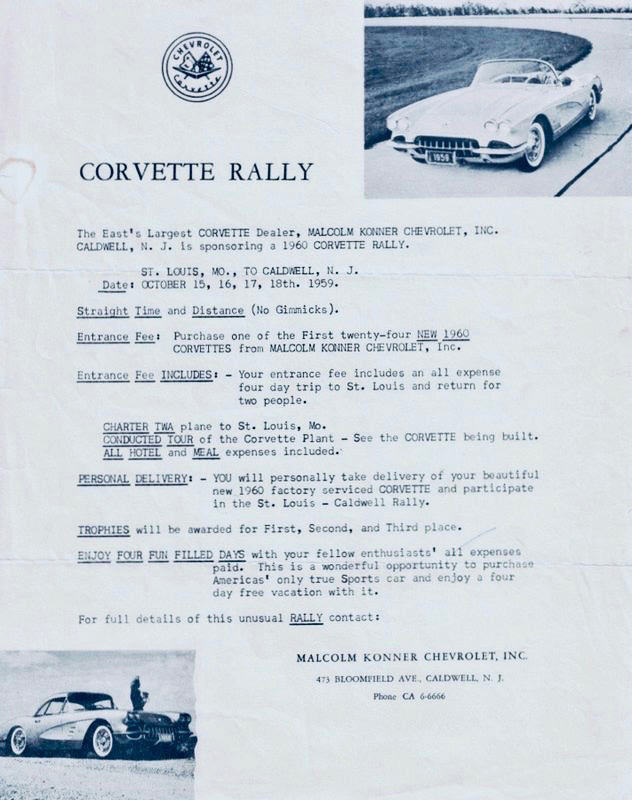
Many of you may have seen the throwback pics last weekend from National Corvette Seller Mike Furman who shared a number of photos featuring Chevrolet dealer Malcolm Konner who took 50 people (25 customers) to the Corvette Assembly Plant in St. Louis in October 1959 to pick up their new 1960 Corvettes at the factory and they would drive them home to New Jersey.
We’ve actually done a previous Throwback Thursday post about this trip back in 2017, but last week we got a whole new look as Malcolm Konner’s son RJ Konner shared these two home videos to Facebook showing the trip to St. Louis (and even some scenes from inside the factory) before the 25 new Corvette owners headed home to Konner Chevrolet in New Jersey via a timed road rally. Waiting for them in New Jersey was the famous entertainer Pat Boone who was a personal friend of Malcolm and a Corvette customer.
Along the way the camera captures scenes of late-1950’s Americana featuring wide-open highways to drive on and stays at the Holiday Inn.
Check out the official invitation for the Personal 1960 Corvette Delivery at the plant, as well as the Road Rally plans:
It’s really amazing that Malcolm was able to put a trip like this together just six years into the production of the sports car, and it also says a lot about his customer’s passion for the new Corvette to jet off to St.Louis and then drive halfway across the country to back home. Just the logistics of chartering a TWA airplane and then planning the drive home must have taken some planning as the national highway system has just started construction three years prior.
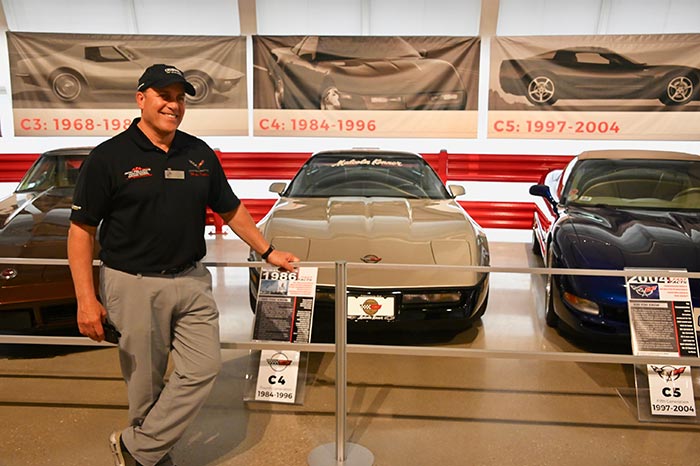
This trip made such a lasting memory that the Konner family would do it again in the Spring of 1986. Malcolm had passed away a few years before and Chevrolet authorized the first-ever run of 50 special edition 1986 Corvettes dedicated to the dealer called the Malcolm Konner editions. The Konners brought a group of customers to the Bowling Green Assembly Plant and they would all drive them back to Konner Chevrolet in New Jersey.
Here are the photos from the St, Louis to New Jersey 1959 Corvette Road Rally:
And here is a quick look at those 50 1986 Malcolm Konner Editions:
Finally, here is our friend Mike Furman with one of the Malcolm Konner Special Edition 1986 Corvettes. Mike started working in automobile sales at Malcolm Konner Auto Group in the summer of 1978 at the age of 17 years old!
Rare home movies chronicle the first Corvettes going into production. Each one is built by hand at the GM factory in Flint, Michigan. Only 300 Corvettes were built that first year. All 1953 Corvettes were white with a red interior, all had Powerglide automatic transmissions mated to 150 HP, six cylinder engines with three carburetors and dual exhaust. Of those 300, 255 survived.
Corey Peterson brought his 1953 Corvette VIN 001 to Bloomington Gold 2024 and did a Question and Answer session about the car. Documentation from the GM Archives shows that the VIN 001 and VIN 002 cars were used for further engineering updates. Further examination of the long lost Corvette shows the documented updates that were performed on them.