These three see-through Corvettes hold significant parts of Chevy history
By Jim Koscs on Jan 6th, 2021 at 9:00 am
/stories/2020/12/23123042/See-Thru-Vettes-group-e1608748876548.jpg)
The unmistakable sound of a Chevy big-block through Corvette exhausts would not stand out as unusual at a New York Chevy dealer’s Corvette show. But when a few showgoers turned their heads to glance at the “car” they heard approaching the event back in 1990, eyes popped and jaws dropped.“It’s not a car! It’s just a chassis – with a guy driving it!”The “car,” which was wearing the chrome bumpers of a C2 Corvette, made several passes by the dealership, and before long the show crowd had moved to the street to get a closer look. After about 10 minutes of teasing the ‘Vette fans, the driver pulled into the lot and then into the showroom. The crowd rushed to follow.The driver, Kevin Mackay, had trailered the bodyless 1965 Corvette to a spot about a block away from the show and then drove it there to make a grand entrance. “They could not believe it was driveable,” Mackay recalls for Hemmings. “People went crazy over it.”The driveable ’65 chassis was part fun surprise for Corvette buffs and part promotional tool for Mackay’s business, Corvette Repair in Valley Stream, New York, opened in 1985. The shop has restored many of the world’s rarest and most valuable Corvette production models, historic race cars, and factory development cars and prototypes. Mackay’s restorations have earned more than 1,500 awards for clients, including legendary New York Yankee slugger, Major League Baseball Hall of Famer, and noted car collector Reggie “Mr. October” Jackson. The baseball great referred to Mackay as “The Mr. October of Corvettes” in the foreword he wrote for Mackay’s book, “The Corvette Hunter.”
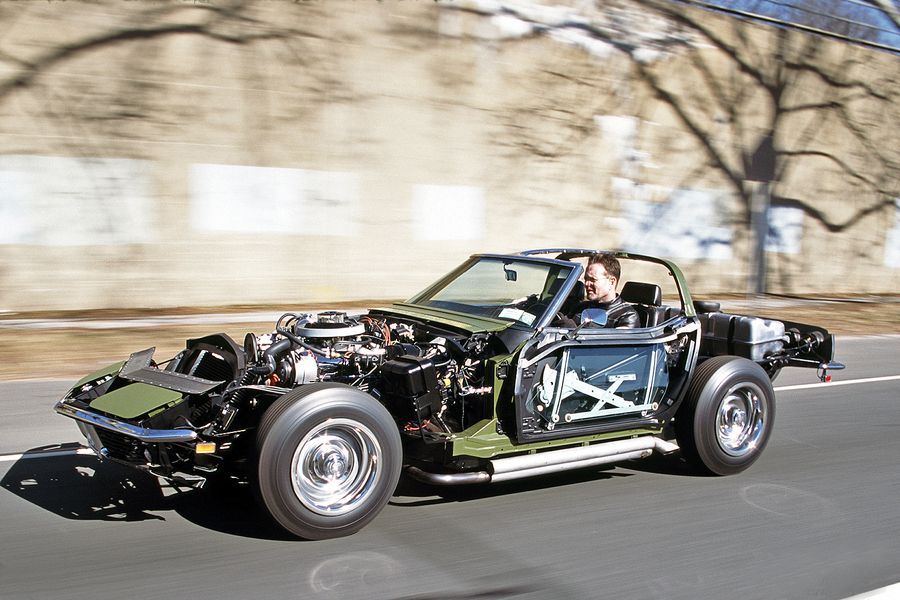
Mackay and his team of craftsmen would go on to build numerous other special display Corvettes, each more surprising and intricate than the last. The culmination of that work so far stands as three “See-Thru” Corvettes, representing each of the car’s first three generations. Beneath the mind-blowing bodywork, each See-Thru car holds a special, historic surprise: The ’69 is one of 116 factory L88 models made that year, the’65 is powered by a top-secret big-block engine from the Mk. IV development program and was used in one of the five Corvette Grand Sport racers. And the ’53 sits on the oldest Corvette chassis known to exist, #003.Rest assured, Mackay and his team did not simply tear up three historic Corvettes to build these See-Thru models. Each was constructed differently, and all required extraordinary creativity, ingenuity and craftsmanship to be made driveable. (Mackay’s ’69 L88 will be returned to stock with its original body.)The featured photos, taken in 2018, are from the first and last time the three cars have been together. They were joined in the photo shoot by the driveable chassis of the 1964 Corvette XP-819 rear-engine development car, also restored by Corvette Repair. Mackay had debuted the chassis at the 2013 Amelia Island Concours, and then the completed XP-819 at the 2020 Amelia Island Concours. The car is currently on loan by its owner to the National Corvette Museum for the mid-engine model display.
“You Have to Stand Out”
Mackay had established a reputation for quality Corvette restorations starting with his own ’65 and ’67 coupes, but he wanted to do even more to demonstrate his team’s capabilities while also engaging the Corvette hobby. He recalled advice from his father, who initially did not approve of his career but became a supporter. “He told me I had to figure out a way to make myself stand out,” Mackay recalls. That spurred the idea to showcase restoration work that normally goes unseen.
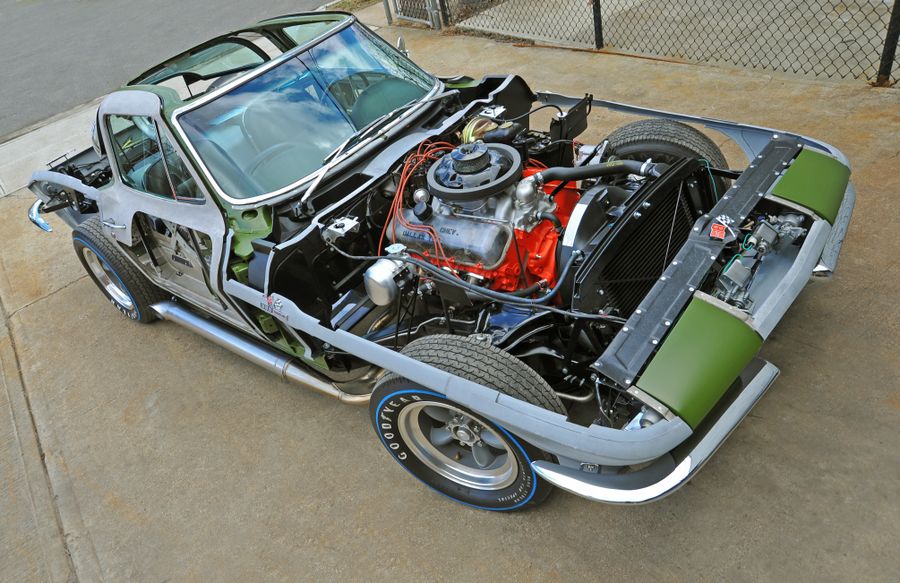
“Eighty-percent of a restoration gets hidden by the body, so we would bring the restored rolling chassis to local shows,” Mackay says. “These would draw bigger crowds than the cars. People would surround them, take pictures and ask questions. They could see the inner workings of a Corvette and how it was built, which was a great way to learn, and they could also see the quality of our work.”Energized by the reception the first rolling chassis received, Mackay stretched the idea. “Looking at the rolling chassis, I thought it wouldn’t take much work to make it driveable,” he says. “We could install the bumpers, pedals, brake master cylinder and a driver’s seat. So we did that with the Bounty Hunter car we were restoring.”The Bounty Hunter was a ’67 427/435 coupe steeped in local New York notoriety. It was also one of just a handful of Tuxedo Black Corvettes that had a red interior. The car was originally used as a demo and drag-raced by Vernon Turner, a salesman at Krieger Chevrolet-Oldsmobile in Woodbridge, New York. Turner named the car Bounty Hunter after Top Fuel dragster racer Connie Kalitta and his cars. Turner, who was reputedly connected to organized crime, was ultimately found murdered.Mackay’s restoration earned the car National Corvette Restorers Society Top Flight and Bloomington Gold honors, among other awards. It was judged Top Flight status with its Bounty Hunter lettering and Cragar GT mag wheels, which is how the dealer sold the car in 1967. (Mackay was able to hunt down a set of the correct wheels in Hemmings.)
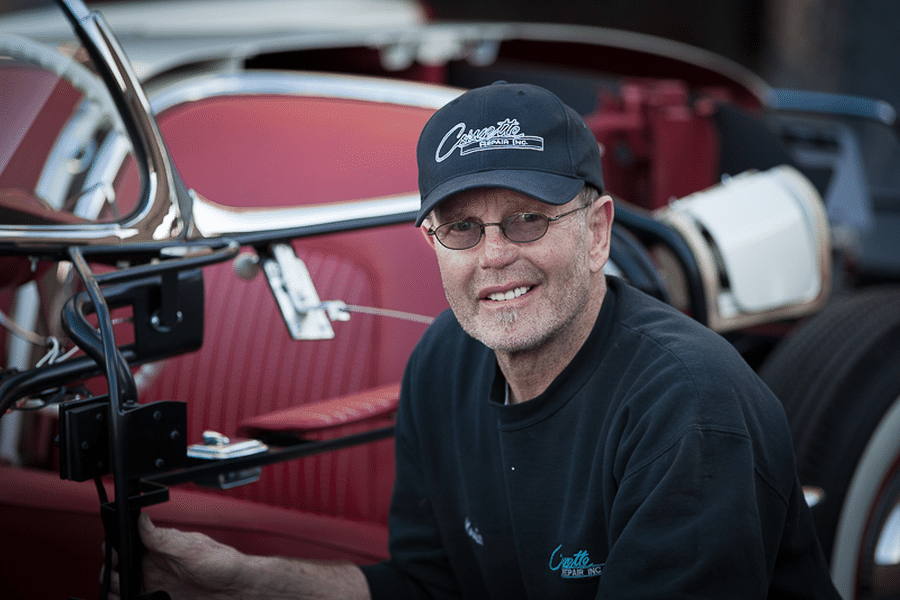
Kevin Mackay in front of one of his creations. Photo via the <a href=”https://www.facebook.com/corvetterepair/”>Corvette Repair Facebook pag</a>e.Among the car’s enthusiastic fans at Bloomington Gold was the Corvette’s godfather, Zora Arkus-Duntov, who happily autographed one of the car’s valve covers. “That car got a ton of media coverage when we finished the restoration,” says Mackay. “There were a lot of articles written about it.”